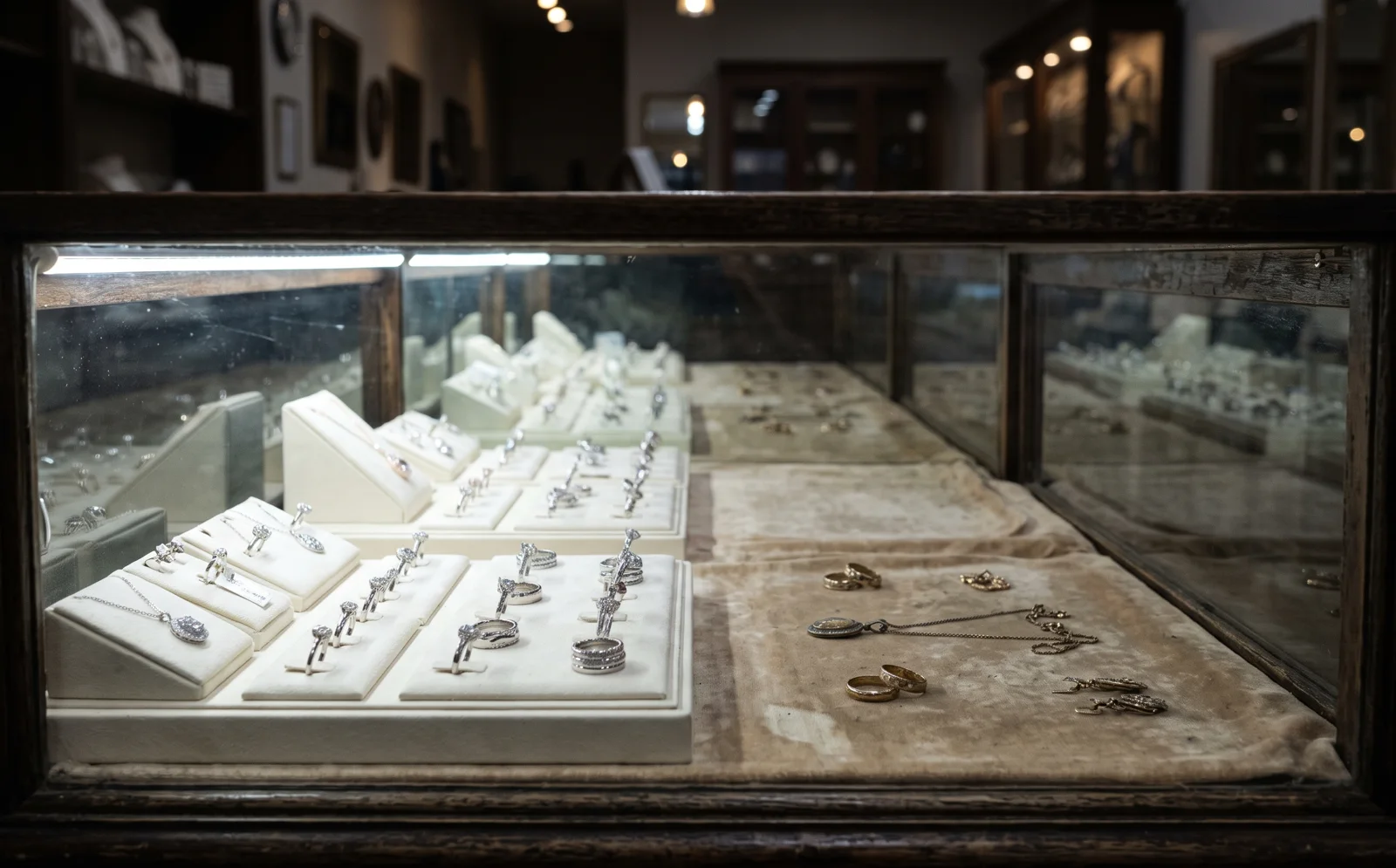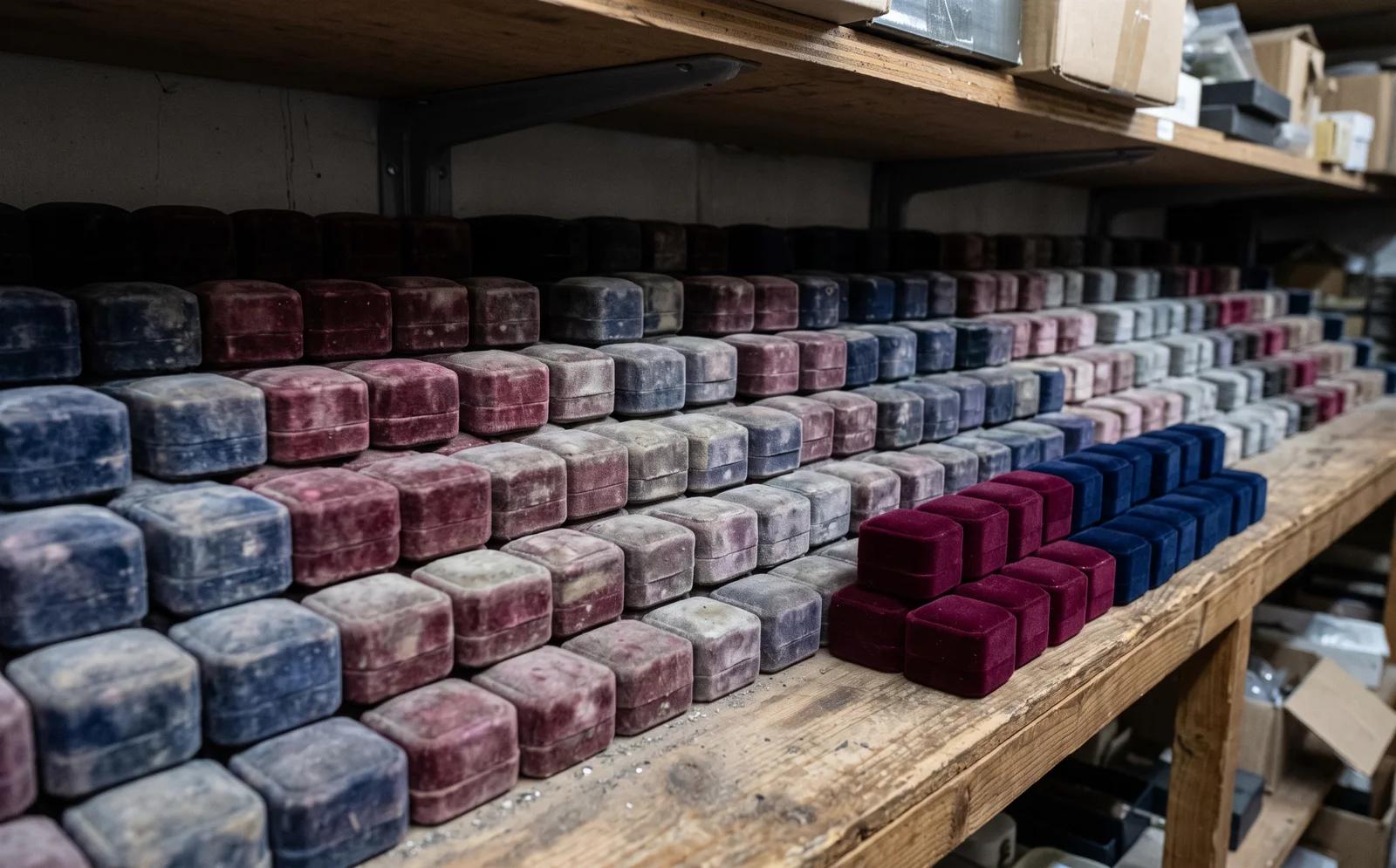
Short answer: the trade's target for aged inventory is around 20 percent of total stock. JCK has reported that in many jewelry stores over half the inventory on offer is aged. That gap is where the cash, the debt and most of the strategic conversation in jewelry retail actually live.
What to do about it is genuinely contested, by named people, in public. That disagreement is worth understanding before you pick a side.
The threshold and the target
Aged means 365 days in most of the trade's material. David Geller's rule, reported by INSTORE, is that items over 366 days get discounted 50 percent off everything, and "once it reaches 366 days. OUT IT GOES."
JCK makes the comparative point that puts this in perspective: fashion retail considers items aged after three to six months, while jewelry stores often wait a year or longer. Jewelry's threshold is already generous by retail standards.
The target share is 20 percent. INSTORE attributes that figure to Dick Abbott of The Edge. Abe Sherman corroborates it as a health marker rather than a hard rule: "A company with 20% aged inventory is in far better shape than a company with 60% aged inventory."
The reported reality is much worse. JCK's coverage describes stores where "over half of the total inventory being offered to customers is aged inventory."
BIG's case-study data puts numbers to individual stores. One store carried 57 percent of owned inventory over one year old, with aged inventory up $500,000 from end of 2021, on-hand up $400,000 over three years while cost of goods sold declined $138,000. Another had asset inventory up $850,000 from 2021, aged inventory nearly doubled from 2021 lows, and COGS down $300,000 by 2023.
Read those two together: more stock, older stock, and less selling. That is the shape of the problem.
The 2021 detail nobody wants to talk about
BIG's most uncomfortable finding is not the percentages. It is that the trade already proved it could fix this and then stopped.
In 2021, one of those stores sold down $600,000 in aged inventory and lowered year-end inventory by $300,000. The discipline was real, it worked, and it was abandoned once sales recovered. Sherman's argument is that pandemic-era rigour lasted exactly as long as it was forced.
Which suggests aged inventory is not primarily an analytical problem. Most owners can see it. It is a decision problem, and decisions get easier to defer when the top line looks fine.
What holding it actually costs
David Brown of Edge Retail Academy gives the number most likely to change behaviour: "Most financial and industry experts agree that the 'holding cost' associated with non-performing inventory is 20% per annum."
In money: "For every $100,000 you are overstocked you will be looking at $5,000 to $20,000 in holding costs."
His component build-up for a single $100 item held twelve months is worth reproducing because it makes the abstraction concrete — vendor cost $100, staff time $10, freight $5, interest at 5 percent $5, staff cleaning and other $10, giving "$130 cost for this item in just 12 months."
Geller adds the balance-sheet version, and it is the sharpest claim in the whole debate: aged inventory "shows up almost dollar for dollar with accounts payable debt, credit card debt and bank loans."
The mechanism is not mysterious. Stock that does not sell was bought with money, and that money came from a vendor, a card or a bank. Aged inventory is the debt, wearing a different label and sitting in a case. The store Geller featured, after applying his rule, reported sales up 30 percent for the year and debt reduced to almost zero.
The disagreement worth understanding
Here are two named authorities, both credible, giving opposite advice.
Geller's position: a hard cutoff. Aged at 365 days. Over 366, discount 50 percent, and out it goes. The logic is that carrying cost compounds, the capital has alternative uses, and a piece that has not sold in a year has told you something. Waiting is a decision with a price.
Sherman's position: jewelry has no expiration date. His posture is "sell down, not buy more," but not necessarily "discount and dump." Jewelry "won't spoil," so the alternative to a markdown is re-merchandising — and specifically, "you can shuffle your inventory into different price points depending on what's happening with the prices of metals." A piece wrong at one price point can be right at another without conceding margin.
Both are right about different stock, which is the practical resolution. The question that separates them is why a given piece has not sold:
- Wrong for your market, wrong forever → Geller is right. Take the 50 percent and free the capital.
- Right piece, wrong price point or wrong presentation → Sherman is right. Re-merchandise before you concede margin.
- Right piece, right price, never actually shown → neither is the issue. Fix the merchandising.
What is not defensible is the fourth option, which is what most stores do: carry it at full price, in a drawer, indefinitely, while paying 20 percent a year for the privilege.
Moving it: what the trade actually recommends
JCK's published tactics are notable for being entirely about sell-through rather than disposal:
- Reprice it to sell now. "Consider readjusting the list price to arrive at the right price point . . . even if the margin is less."
- Pay extra commission to sales staff on featured aged merchandise.
- Recognise associates each time they sell an aged item.
- Sell by season.
- Group aged pieces with similar matching jewelry for "implied acceptance."
A dedicated clearance showcase is the other common approach, and the trade is split on it. INSTORE's panel came out 43 percent with a clearance case against 57 percent without — though one respondent reported "$75,000 in 18 inches of showcase" in six months.
One honest gap in the literature: there is no published data on scrap, return-to-vendor, remount or trade-in rates, or what recovery percentage each route yields. The trade discusses all four constantly and nobody publishes the numbers. If someone quotes you one, ask where it came from.
Getting the measurement right first
Two things will make your aged number wrong before you act on it.
Memo goods in the calculation. Consigned stock is not yours — under US GAAP it stays on the consignor's balance sheet until control transfers — so it should not be in either the numerator or the denominator of an aged-stock percentage. More here.
No category breakdown. A store-wide aged percentage is a blunt instrument. Aged bridal semi-mount and aged fashion silver are different problems requiring different answers, and the same is true across price points, where BIG's turn data shows a spread from 0.32 to 3.31 inside single categories.
Pair aged analysis with GMROI by category. Aged stock in a category running $1.60 GMROI is probably a merchandising problem worth solving. Aged stock in a category running $0.70 is a category you should stop buying.
Where Jewelia fits
Aged analysis is only useful if it is standing rather than annual. Analytics includes inventory aging among more than 40 built-in reports across nine categories, alongside inventory value at cost and retail, inventory by location, and a replacement valuation at today's metal spot prices — so the 20-percent question is a screen rather than a project.
Inventory carries cost, retail and receipt date per item across stores, safes and cases with jewelry-specific fields and bulk repricing, which is what makes Sherman's re-merchandising approach practical: shifting a group of pieces into a different price point as metal moves is a bulk edit rather than a week of relabelling. Memo goods sit in Memo & Ledger, out of your stock value.
And Jewelia AI suits the recurring form of this question — what has not sold in over a year, which categories hold the most of it, what it is worth at cost — asked repeatedly without building a report each time.
Bottom line
Target 20 percent aged, measure it by category rather than store-wide, and keep memo goods out of the calculation. Price the holding cost at around 20 percent a year so the decision to wait has a visible number attached. Then decide piece by piece which argument applies: Geller's cutoff for stock that is wrong for your market, Sherman's re-merchandising for stock that is merely in the wrong place. The one position with no support from anybody is doing neither.
Frequently asked questions
- When does jewelry inventory count as aged?
- The common threshold in the trade is 365 days. David Geller's rule is that items over 366 days get discounted 50 percent and go out. JCK notes the contrast with fashion retail, which typically treats goods as aged after three to six months while jewelry stores often wait a year or longer.
- What share of stock should be aged?
- Around 20 percent of total inventory, a target attributed to Dick Abbott of The Edge and echoed by Abe Sherman, whose framing is that a company with 20 percent aged inventory is in far better shape than one with 60 percent. JCK has reported that in many stores over half the inventory being offered to customers is aged.
- What does aged inventory actually cost to hold?
- David Brown of Edge Retail Academy cites a holding cost of around 20 percent per annum on non-performing inventory: for every $100,000 you are overstocked, $5,000 to $20,000 in holding costs. His build-up for a $100 item held twelve months — cost, staff time, freight, interest and handling — reaches $130.
- Should I discount aged stock or wait it out?
- The trade genuinely disagrees. Geller's position is a hard 366-day cutoff at 50 percent off. Sherman's is that jewelry has no expiration date and can be re-merchandised into different price points as metal prices move. Both are named authorities; the resolution is usually that the answer differs by category and by why the piece is not selling.
- Is there a link between aged inventory and debt?
- Geller argues there is, and states it starkly: aged inventory shows up almost dollar for dollar with accounts payable debt, credit card debt and bank loans. The mechanism is straightforward — stock that does not sell was bought with money that has to come from somewhere.
- What is the fastest way to move aged stock?
- JCK's published list is all sell-through rather than disposal: reprice to sell now even at lower margin, pay extra commission on featured aged merchandise, recognise associates when they sell aged pieces, sell by season, and group aged pieces with matching designs for implied acceptance.
Stop reading, start clicking.
Open a live Jewelia company with real inventory, memo, jobs and reports already in it. One work email, no card, no sales call, nothing to install.