
Jewelry memo software that ends the chasing.
See what’s out on memo, what’s due back and who owes what — then share a live statement so nobody has to hunt for a payment receipt to prove they settled.


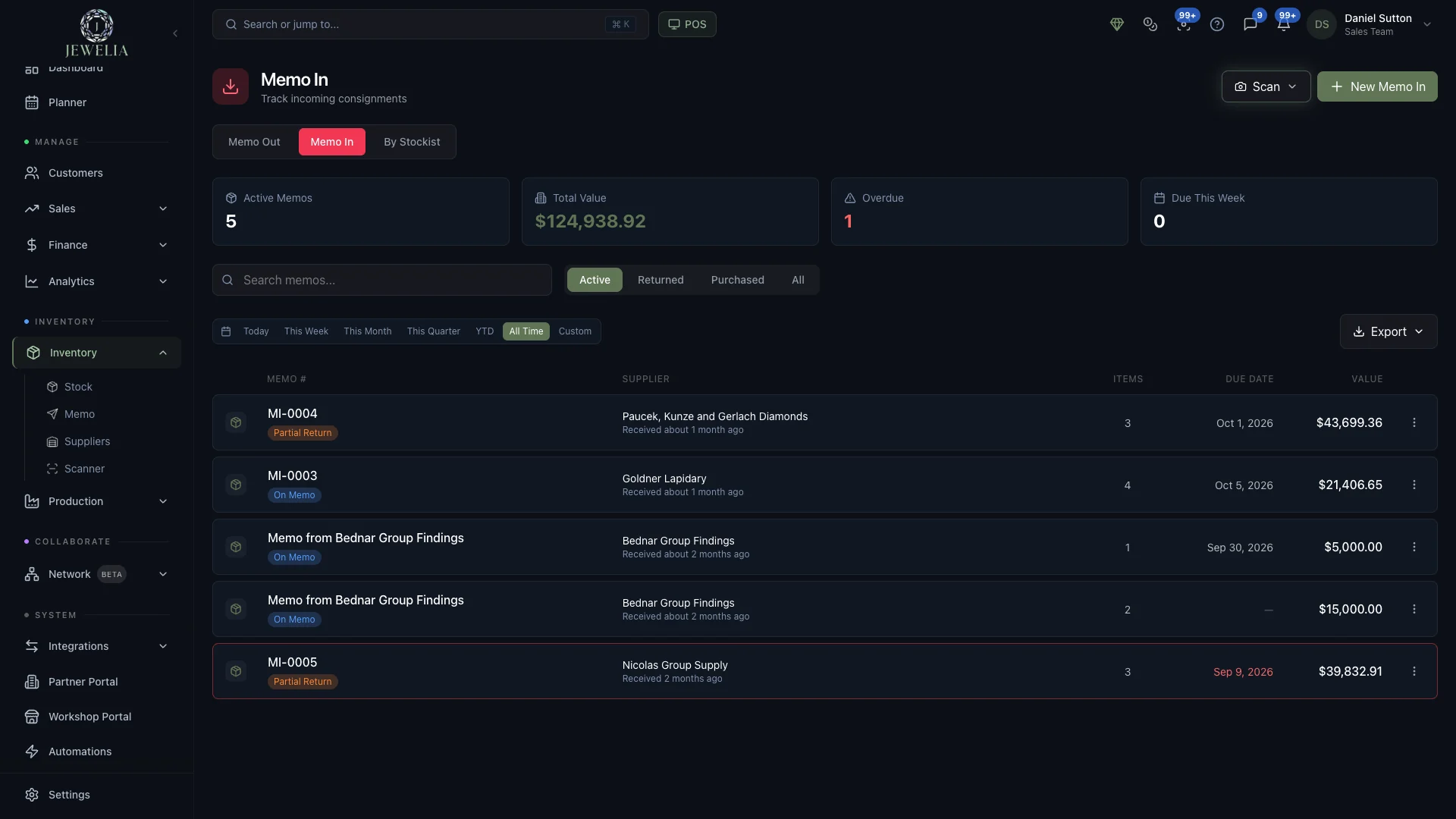
What is Jewelia Memo & Ledger?
Consigned goods, tracked like the asset they are
A piece out on memo is still yours. A piece in on memo is still theirs. Everything difficult about consignment follows from those two sentences. Jewelia is cloud jewelry memo and consignment software: memo goods stay separate from stock you own, and the Ledger shows a netted balance with each counterparty, so reconciliation is a shared screen rather than two spreadsheets that disagree.
Goods out and nobody is sure where
What it costs youPieces at a stockist, in a rep's bag, at a show. It is still your stock and your money, and the answer to "where is it?" is a phone call.
How Jewelia solves itMemo out tracked line by line with terms, due dates and the counterparty, so what is out, with whom and since when is one screen.See how
Partial returns that never add up
What it costs youTwelve pieces out, seven back, two sold at a different price. The paperwork never reconciles and someone eats the difference.
How Jewelia solves itPartial returns and sold-with-price on the same memo; a sold memo converts to an invoice or a bill in one click.See how
Two ledgers that disagree
What it costs youYour spreadsheet says they owe $18,400; theirs says $14,200. The relationship pays for the gap.
How Jewelia solves itThe Ledger nets what is owed both ways per account, with aging and applied payments, and a live statement you can share so it is settled on one screen.See how
Memo goods mixed into your valuation
What it costs youSupplier pieces sit beside your own inventory. Your stock value is wrong and so is your insurance.
How Jewelia solves itMemo in tracked apart from owned stock, so the valuation stays honest while the piece still sits in your case.See how
Chasing after it is already awkward
What it costs youMemo past 60 days that nobody noticed until it was past 120, and a call that now has to be difficult.
How Jewelia solves it30/60/90 aging on every account, and Jewelia AI drafts the recall notes for you to approve.See how
What's out on memo
Every piece sent on memo carries terms, a due date and a PDF — so consigned goods are a tracked position, not a note in someone's phone.
What's in from suppliers
Goods received on memo from a supplier stay separate from stock you own, because they are not yours until they sell.
What's overdue
30/60/90-day aging buckets, overdue counts and automatic reminders before the due date — so chasing starts before the call gets awkward.
Who owes what
A shared Ledger nets what they owe you against what you owe them, per account — and you can send a live statement link to a counterparty if you want them to see it, or keep it to yourself.
One screen instead of six open tabs and a phone call.
Most consignment gets run out of a spreadsheet, an email thread and memory. The moment a parcel is split, or a partner pays against three memos at once, that arrangement stops agreeing with itself — and the reconciliation lands on whoever is least able to refuse it.
- Active memos, total value out and overdue count, live
- Filter by supplier, stockist, date range or status
- Export the position whenever your accountant asks for it

Why a spreadsheet gives out
Four moments that break consignment tracking
Memo looks simple until the first parcel comes back in pieces. These are the four points where a tab in a workbook quietly stops being a record of the truth.
Three go out, two come back, one sells
Partial returns are the normal case in memo, not the exception. A spreadsheet row for the whole shipment cannot say that line two sold at an agreed price, line three came back, and line one is still out — which is why reconciliation turns into a phone call.
Goods in your safe that you don't own
Memo stock from a supplier is their property until it sells. Count it as your inventory and you overstate what you own; leave it out entirely and you cannot sell it. Jewelia keeps memo-in goods tracked but separate, so valuation and availability are both right.
Nobody agrees on what arrived
The classic consignment dispute is a parcel whose contents are remembered differently at each end. A confirmation link lets the other side tick off what actually arrived, line by line, with photos — no account, no login, and a record afterwards.
“We paid that in March”
Balances drift when each side keeps its own tally and payment proof lives in a text thread. A shared statement replaces both tallies with one page showing debits, credits, applied payments and the netted balance — the same page for both of you.
Both directions
Memo out and memo in, on the same ledger
Most jewelry businesses do both — you send goods on approval and you hold someone else’s. Running those in two systems is how balances drift.
Goods you send on approval
To a retailer, a partner store, a show, or a sales rep on the road. You keep ownership until it sells — so you need to know where every piece is and when it is due back.
- Terms, due dates and a PDF memo document on every shipment
- Partial returns and sold-with-price, tracked line by line
- Aging buckets and overdue counts, with reminders before the due date
- One click from memo to invoice when the piece sells
- A memo portal where consignment partners confirm goods and see their account
Goods you receive on approval
Loose stones from a dealer, finished pieces from a brand, a parcel for a specific customer. It sits in your case, it is not yours, and it has to be returned or paid for.
- Tracked separately from owned stock, so valuation stays honest
- Confirm what arrived line by line, with photos, and log any discrepancy
- Sell a memo'd stone and the supplier balance moves on the shared ledger
- One click from memo to bill when you decide to keep it
- Memo analytics: what you hold, from whom, for how long
The Ledger
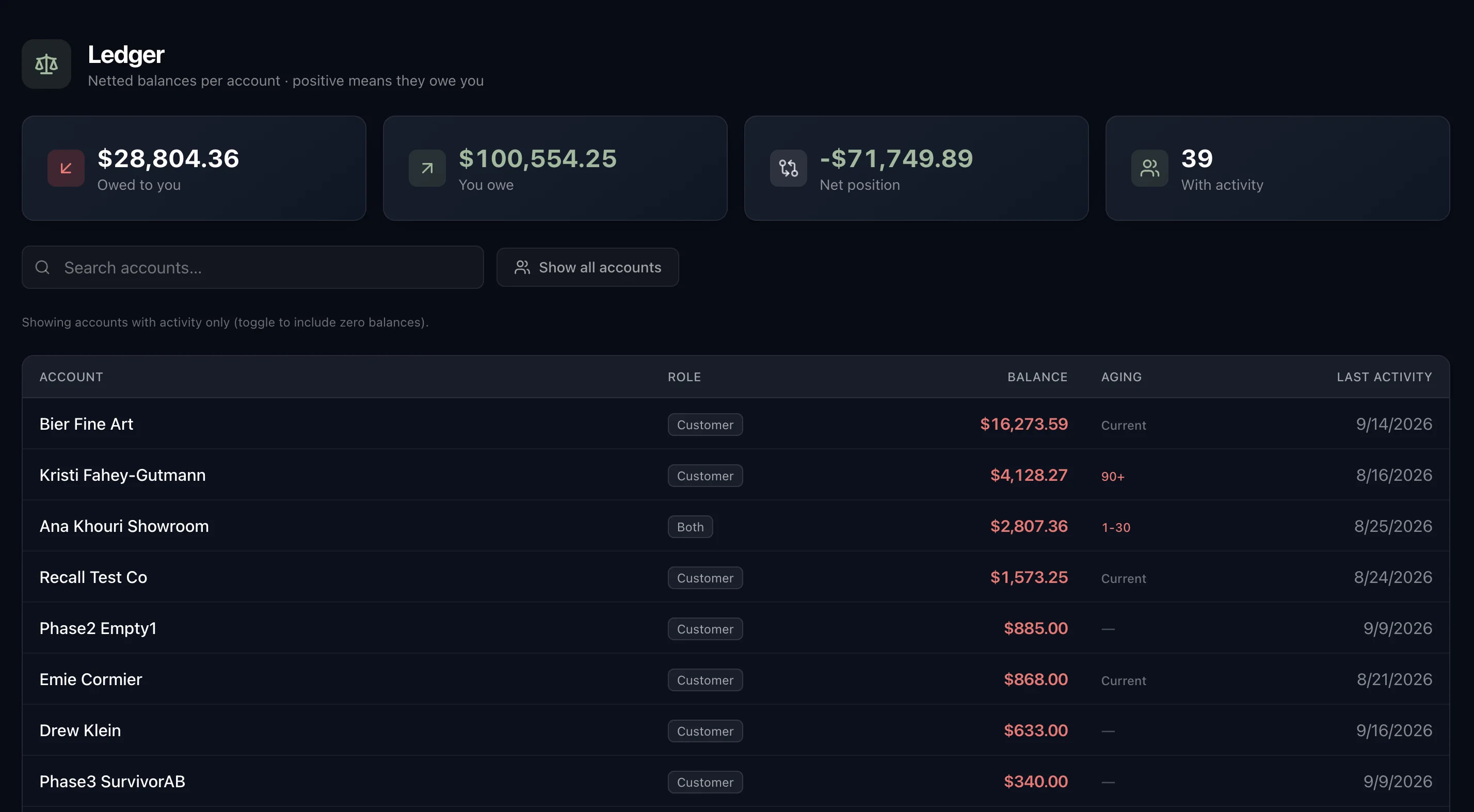
One balance per account. Both of you looking at it.
Memo and money are the same conversation, so they live in the same place. Every memo, invoice, bill and payment posts to a shared ledger that nets what they owe you against what you owe them — and the statement is a link you send, not an attachment that is out of date by the time it arrives.
- Netted balances per accountOwed to you, owed by you, net position — one number per supplier or customer instead of two competing spreadsheets.
- A statement you can share — if you want toSharing is per account and entirely optional: nothing is visible to a counterparty until you send them the link, and you can revoke it. Share with one and not another, send a live link that updates as entries post, or just export a PDF and keep the ledger to yourself.
- Applied paymentsRecord method, reference and which order a payment settles, so every dollar is traceable back to a document.
- Aging by counterpartySee which balances are 30, 60 or 90 days out, so you chase the right account first instead of the loudest one.
- Goods on memo, held separatelyConsigned units sitting with a counterparty show on the account as a memorandum, outside the money balance where they belong.
Statements can be shared as a live link or exported and forwarded.
Live demo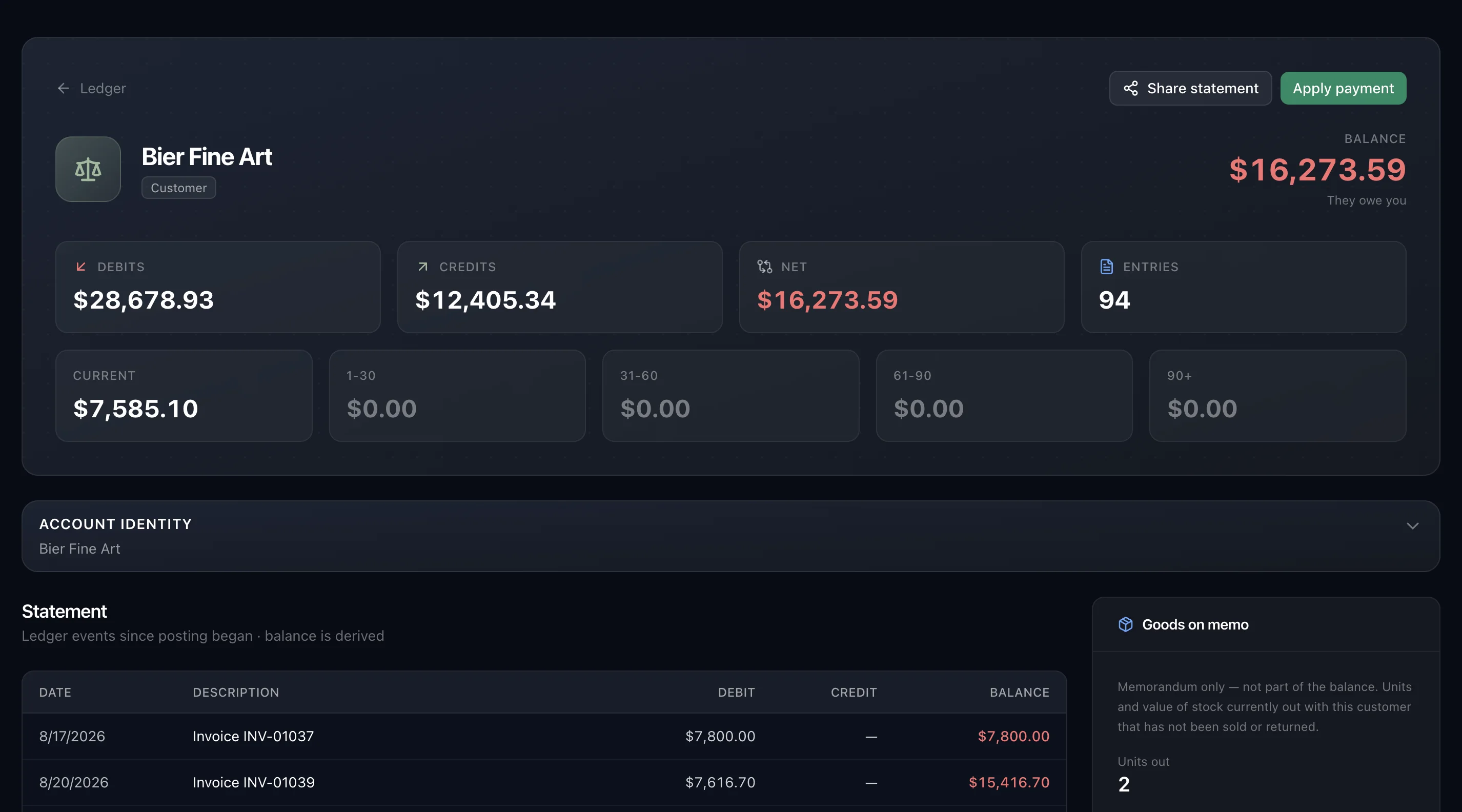
Everything jewelry consignment software has to do
Built for the way the trade actually moves goods on approval — not a generic consignment module with a jewelry label on it.
Outbound memos
Send items to customers, partner stores or reps on approval with terms, due dates and a PDF memo document.
Inbound memos
Receive goods from vendors with the same accountability, so you always know what's due back and to whom.
Partial returns
Return three, sell two at agreed prices, keep one out — every line tracked independently rather than as one shipment.
Sold with price
Record what a consigned piece actually sold for, so settlement matches reality instead of the list price.
Aging & overdue
30/60/90-day buckets and overdue counts at a glance, with automatic reminders sent before the due date.
Convert to invoice or bill
One click from memo to invoice on the way out, or to a bill on the way in. Nothing is re-keyed.
Confirmation by link
The other side confirms what arrived line by line, with photos, from a link — no account needed.
Discrepancy handling
When what arrived differs from what was sent, log the difference and resolve it on the memo itself.
Memo portal
Consignment partners confirm goods and view their own account without emailing you for a copy.
Not a standalone tracker
Memo is a state your inventory is in.
Consignment tracking bolted on beside a stock system always drifts, because two systems mean two opinions about where a stone is. In Jewelia, memo is not a separate list — it is what your existing inventory record says about a piece that is currently sitting somewhere else.
So the same piece can be received on memo, shown to a customer, sold at the counter and settled with the supplier without being entered anywhere twice.
- Inventory Memo goods move in and out of stock as they travel, and memo-in stock is never counted as something you own.
- Point of Sale Sell a memo'd stone at the counter and the supplier balance moves with the sale, so you bill what you owe.
- Sales & CRM Every memo sits on the counterparty's record alongside orders, invoices and history.
- Analytics Value out on memo, aging and overdue positions by counterparty, as a dashboard rather than a spreadsheet.
Both ends of the same parcel
Retailers
You hold stones and finished pieces from suppliers that you have not bought yet. Memo in keeps them out of your owned valuation while still being sellable at the counter.
Wholesalers & suppliers
You place goods with dozens of stores and reps. Memo out gives every one of them terms, a due date, a document and an aging bucket instead of an honour system.
Designers & brands
Your line sits in stores you do not control. A shared statement means settlement is a page both sides read, not a negotiation from two spreadsheets.
Jewelry memo & consignment: questions
What is jewelry memo software?
Jewelry memo software records goods sent out or received on memo — consignment, or goods on approval — so both sides know who holds what, on what terms, when it is due back, what sold and at what price. Because memo goods remain the sender's property until they sell, the software has to keep them separate from owned inventory rather than folding them into a single stock count. Jewelia includes memo out, memo in, aging, partial returns, PDF memo documents and a shared ledger as a core module rather than an add-on.
What is the difference between memo and consignment in the jewelry trade?
In practice the words are used interchangeably. Both describe goods placed with someone else who has not bought them: the sender keeps ownership, the holder either sells the piece and pays for it or returns it by an agreed date. “Memo” is the more common term in the US diamond and jewelry trade, “consignment” in general retail, and Jewelia treats them as the same workflow — terms, due date, partial returns, sold-with-price and settlement.
How is memo different from a normal sale?
A sale transfers ownership and creates a receivable. A memo transfers possession only. Until the piece sells or is returned, it is still the sender's asset sitting in someone else's safe, which is why it needs a due date, an aging bucket and a document both sides agree on — and why counting memo goods as inventory you own overstates your position.
Can I track memo for loose stones and parcels, not just finished pieces?
Yes. Loose stones, parcels and finished pieces can all go out or come in on memo, with weights, counts and prices captured per line. Partial returns work the same way, so a parcel of ten stones can come back as six returned, three sold at agreed prices and one still out.
Can my supplier or customer see the same ledger?
Only if you choose to share it. Nothing about your ledger is visible to anyone outside your business by default. Each account has a live statement you can send as a link, and when you do, both sides look at the same balance, the same entries and the same applied payments — which is usually what ends the “we already paid that” conversation. Sharing is per account, so you can open the book to one counterparty and not another, and you can revoke a link at any time. Plenty of dealers never share it and use the ledger purely as their own record.
How does the other side confirm what they received?
You send a confirmation link. They tick off what actually arrived line by line and can attach photos, without creating an account. If what arrived differs from what was sent, the discrepancy is logged against the memo and resolved there, so the disagreement has a record instead of a recollection.
Does it handle memo for sales reps carrying goods to customers?
Yes — a rep or salesman carrying a line out to customers is memo out with a different counterparty. The same terms, due dates, partial returns and aging apply, and the goods stay visible as yours while they are on the road.
What happens when a memo'd item sells?
Record it as sold with the price it actually went for, then convert the memo to an invoice on the way out, or to a bill on the way in, in one click. The item leaves the memo position, the ledger balance moves, and nothing is re-keyed into a second system.
Does memo stock get counted in my inventory valuation?
Goods you hold on memo from a supplier are tracked separately from stock you own, because you do not own them until you buy them. Goods you have sent out on memo remain yours and stay in your position, shown as out with a counterparty rather than available on the shelf.
Which plan includes memo and the Ledger?
Memo out and the Ledger are included on Starter, at $179/month. Memo in, with memo analytics, is on Professional at $399/month and above. There is no separate consignment add-on to buy.
Is Jewelia's memo software cloud-based?
Yes. Jewelia runs in a browser, so memo lists, aging and statements are the same whether you open them on a Mac at the bench, on an iPad in the showroom or on a phone at a trade show — with no server to maintain and no install on each machine.
See memo and the Ledger on real data.
30-day money-back guarantee. Cancel any month, no setup fees.