
Your line is in forty stores. Do you know what’s selling in each one?
Jewelry vendor software for brands that sell through retailers. Memo to every store, sell-through by account, trunk shows, factory orders and your reps — one system, with the store as the account and the piece as the record.
Selling to majors? Book a demo built around your accounts

Jewelia for vendors
A brand lives in other people’s cases
A jewelry vendor designs a line, has it made, and then depends on retailers to sell it — usually on memo, often at trunk shows, and through reps who own the relationship. Jewelry vendor software keeps each of those stores as an account with its own memo, sales, balance and buyer, so a brand can see sell-through by store and by piece, run trunk shows without a printout, track factory orders to receiving, and pay reps from the sale itself. Jewelia does this in one cloud system, alongside inventory, production and an AI assistant that answers from your own records.
Sell-through you only hear about at reorder time
What it costs youYou restock what the store asks for, not what is actually selling, and slow pieces sit in forty cases.
How Jewelia solves itSell-through by store, by line and by piece, from the memo, invoices and returns already on each account.See how
Trunk shows run on a printout
What it costs youPieces come back missing or mixed up, and nobody can say which store had them or what sold on the floor.
How Jewelia solves itTrunk-show stock checked out and back in per event, piece by piece, with sales recorded against the store and the rep.
Factory orders tracked in email
What it costs youLate goods are found late, and receiving means re-typing what was already ordered.
How Jewelia solves itPurchase orders to your factories with due dates, and receiving straight into stock.See how
Reps working from their own spreadsheets
What it costs youTerritory disputes, commission arguments, and accounts that leave when the rep does.
How Jewelia solves itRep territories, account ownership and commissions calculated from the sale itself.See how
Stores can't see what's available
What it costs youReorders come by phone or text, and new pieces never make it in front of the buyer.
How Jewelia solves itLine sheets from live inventory, and a Partner Portal where your stores see current stock and ask for it.See how
Department-store orders keyed by hand
What it costs youManual order entry, missed ship windows, chargebacks and a separate EDI provider to pay.
How Jewelia solves itEDI built per trading partner on Enterprise and above.See how
Every store is an account
Sales history, open memo, terms, balance, rep and every message with the buyer — one record per retail account, not a contact in someone's phone.
Sell-through, not guesswork
See what is selling in each store, each line and each piece, so reorders and replenishment follow the data instead of whoever called last.
Factory to case
Purchase orders to your factories with due dates, receiving into stock, and custom orders from stores tracked to delivery.
Reps and trunk shows
Territories, account ownership and commissions for your reps, and trunk-show stock checked out and back in piece by piece.
Four places a brand loses track
The line is good and the stores like it. What slips is everything between the factory and the sale.
You hear about sell-through at reorder time
The store calls when it wants more of something. What isn't selling sits in the case for months, and you find out when it comes back — or doesn't.
Trunk shows run on a printout
Two hundred pieces go out for a weekend. On Monday someone reconciles a list against a tray, and the difference is a conversation with the store.
The factory lives in email
A PO in one thread, a revised date in another, a shipment that arrives with nobody sure what was ordered. Receiving means typing it all in again.
Reps keep the accounts in their heads
Who owns which store, what was promised, which commission is owed — in personal spreadsheets and phones, until a rep leaves and takes the context with them.
Give every store the same, current view of your line.
The buyer at an independent and the planner at a department store want the same thing: what is available now, at their price, and what they already have from you. Jewelia gives them that from live stock instead of last season’s PDF.
- Line sheetsBuild line sheets from your live inventory — images, specs and your price per account — instead of a PDF that is out of date by the time it is opened.
- A portal for your storesRetail partners see current availability in a read-only Partner Portal (10 partners on Professional, 50 on Enterprise) and ask for pieces from there.
- Memo to every storeGoods out on memo with terms and due dates, tracked line by line with partial returns, sold-with-price and 30/60/90 aging per account.
- A balance both sides agree onA netted Ledger per store with a statement link the buyer can open, so settlement is a shared screen rather than two versions of the truth.
- Message the buyer from the accountText and message store buyers from the account record, so the conversation stays with the business instead of on one person's phone.
- Department-store orders by EDIEDI connections built per trading partner on Enterprise and above, so purchase orders, acknowledgements, ship notices and invoices flow without re-keying.
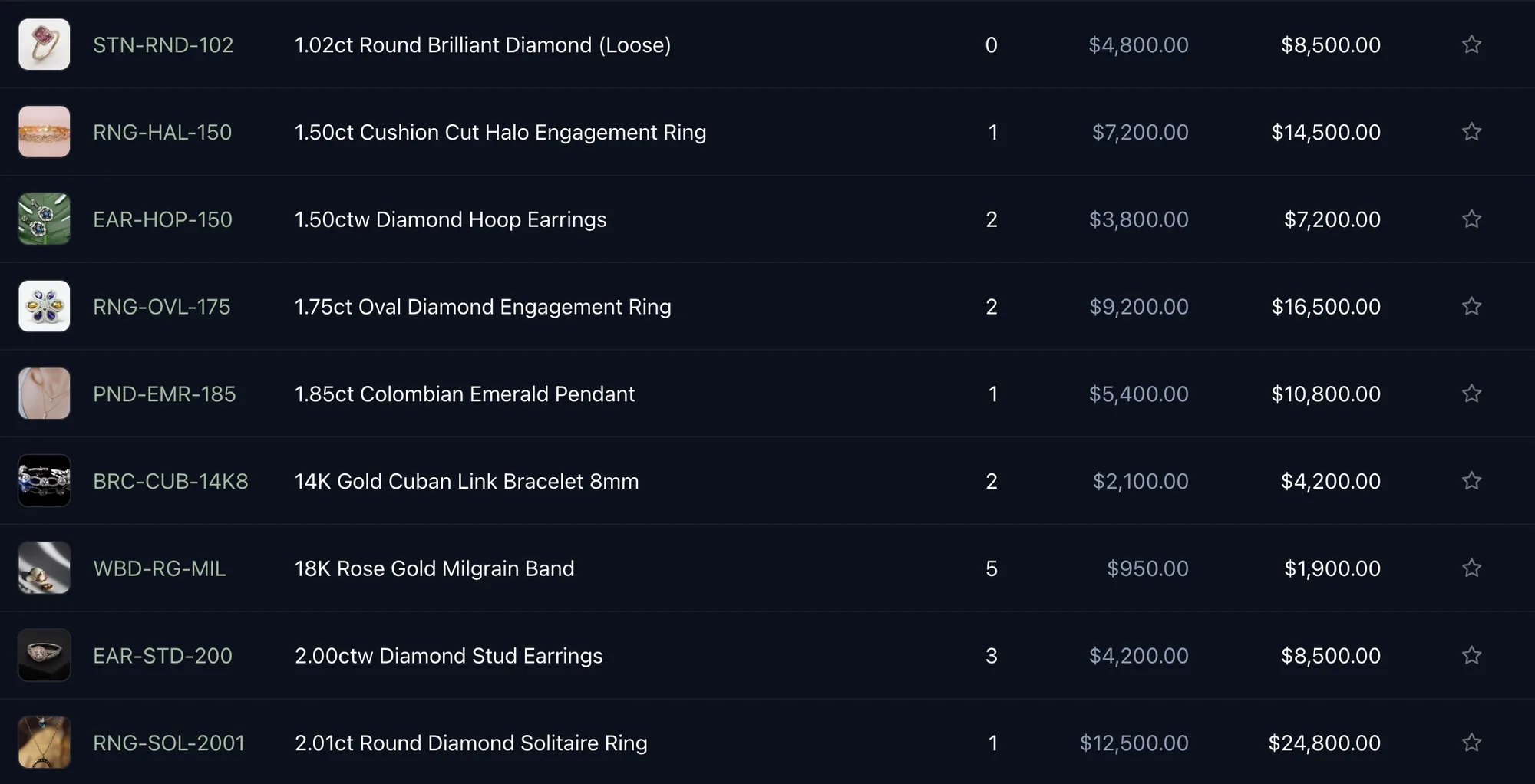
Trunk-show software
A trunk show that closes itself
Two hundred pieces out for a weekend, reconciled piece by piece — with the store’s statement and the rep’s commission settled from the same event.
- Step 1
Check out
Pick the pieces for the event and assign them to the store and dates. They leave your available stock the moment they are packed.
- Step 2
Sell on the floor
Record what sold at the event against the store and the rep, piece by piece.
- Step 3
Check back in
Scan the rest back. Anything missing is flagged against the event, not discovered at the next count.
- Step 4
Settle
The store's statement, the rep's commission and your stock update from the same record — no Monday spreadsheet.
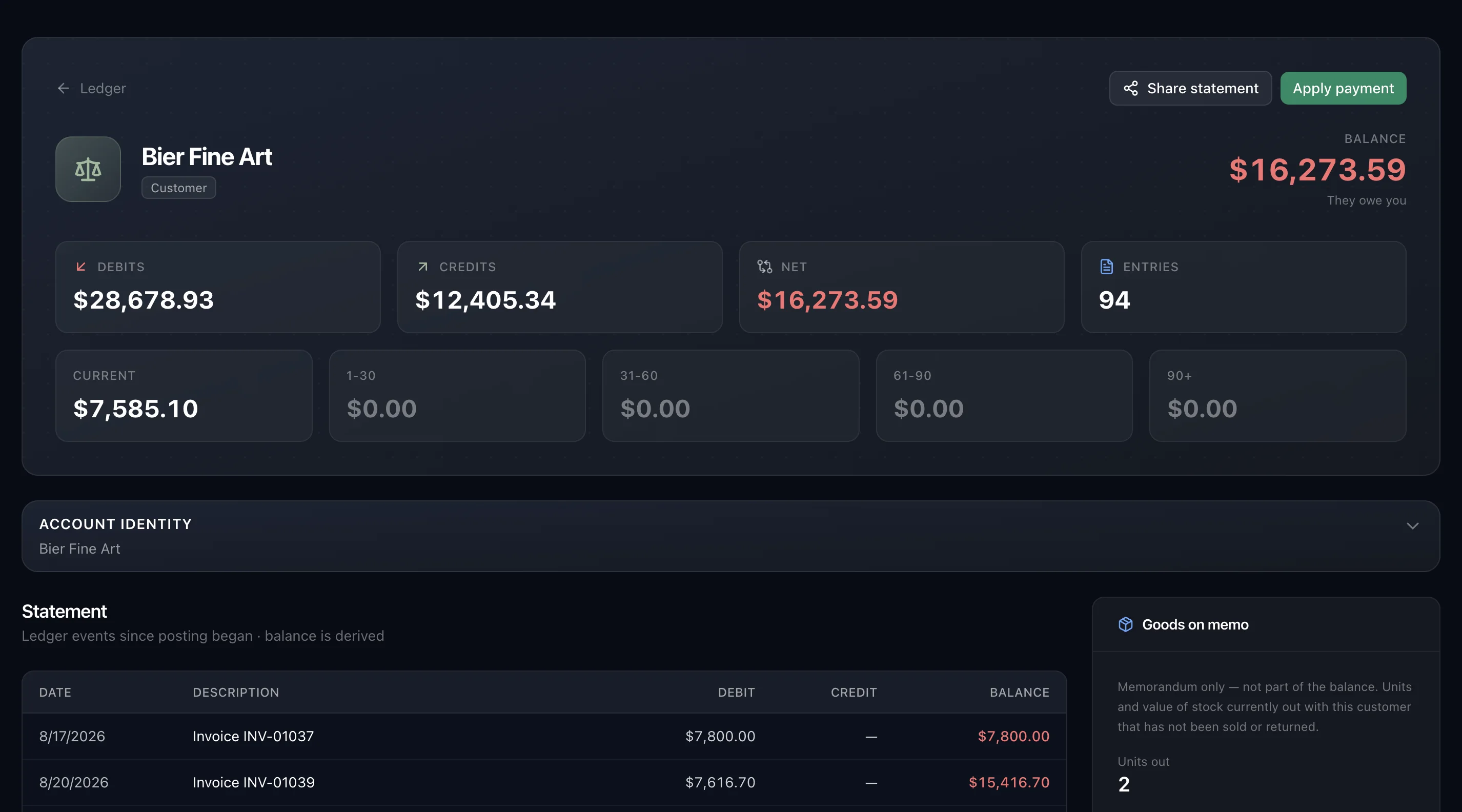
Know what each store owes, holds and sold.
Every account carries its open memo, what sold from it, the invoices that followed and the balance, aged 30/60/90. Pull slow pieces from one store and send them to another that sells that style, and settle with a statement link the buyer opens on their side.
- Sold lines become invoices; the rest can be recalled
- Commission follows the rep who owns the account
- Nothing lives only in a rep's phone
Built for every kind of jewelry brand
Designer & fine-jewelry brands
Collections sold through independent jewelers, with memo to dozens of stores, trunk shows, reps and a wholesale portal for reorders.
Bridal & engagement vendors
Semi-mounts, programs and custom orders from stores, with each retailer's open orders, memo and balance on one account.
Vendors selling to majors
Department-store and chain accounts with EDI, routing and ship notices, alongside the independents you still sell on memo.
Your designs and your accounts stay yours. Cloud by default, a dedicated single-tenant database, or self-hosted on Enterprise and above — every option with two-factor authentication, row-level data isolation and audit logging. How we protect your data
From the factory PO to the store’s statement, one system
Sales & CRM
Retail accounts, reps, pipeline, orders and the history behind every store.
Memo & Ledger
Memo out to stores with aging and partial returns, and a netted balance per account.
Inventory
Every piece with metal, stone and certificate detail, across your showroom, safes and stores.
Production
Factory purchase orders, custom orders from stores, and receiving into stock.
Partner Portal
Where your stores see what you chose to share and ask for it.
Jewelia AI
Ask which stores haven't reordered, which line is slowest, or what's overdue on memo — and act on it.
Moving from another system? See how migration works
Published prices, no setup fees
Paid from day one with a 30-day money-back guarantee. About 17% off on annual billing.
Starter
A brand with a handful of stores
$179/month
$149/month billed annually
- Memo out to stores, with aging & PDFs
- A ledger per retail account
- CRM — 500 accounts & contacts
- Production — 25 active jobs
- Orders, quotes & invoicing
Professional
A line in dozens of stores
$399/month
$333/month billed annually
- Everything in Starter
- Partner Portal — 10 retail partners
- Memo in + memo analytics
- Jewelia AI · 29 reports
- 10,000 items · 5,000 contacts
Enterprise
Selling to majors as well
$999/month
$833/month billed annually
- Everything in Professional
- EDI per trading partner
- Partner Portal — 50 retail partners
- API access & custom roles
- Self-hosting by arrangement
Enterprise Plus is custom, for multi-brand groups. Compare every plan
Jewelry vendor software: questions
What is jewelry vendor software?
Jewelry vendor software is built for jewelry brands that design their own lines and sell them through retailers. It manages the things a store's system doesn't: memo and consignment to many retail accounts, sell-through by store and by piece, trunk shows, sales reps and their commissions, purchase orders to outside factories, line sheets and a portal for reorders, and EDI with department stores. Jewelia does all of that in one cloud system, with an AI assistant that answers questions about your own data.
How is a jewelry vendor different from a wholesaler?
A wholesaler moves stock — loose stones, findings, closeouts, other people's product. A vendor owns a brand and cares how it sells once it is in other people's stores: sell-through, replenishment, trunk shows, reps and the relationship with each retailer. Many businesses are both, and Jewelia covers both; see the wholesaler page for the distribution side.
Can Jewelia track trunk shows?
Yes. Pieces are checked out to a store for an event, sales are recorded against the store and the rep, and the rest are checked back in piece by piece. Anything missing is flagged against the event, and the store's statement, the rep's commission and your stock update from the same record.
Can I see sell-through by store?
Yes. Because memo, invoices and returns sit on each retail account, you can see what sold, what is still out and for how long — by store, by line and by piece — and use it to decide what to replenish and what to pull.
Does it handle purchase orders to our factories?
Yes. Create purchase orders to your factories and outside makers with due dates, track what is late, and receive goods straight into stock so nothing is typed in twice. Custom orders from stores run through production with their own status and delivery date.
Can sales reps have their own territories and commissions?
Yes. Assign accounts and territories to reps, record which rep owns each sale, and calculate commission from the sale itself rather than a month-end spreadsheet.
Do you support EDI with department stores?
Yes. EDI connections are built per trading partner on Enterprise and above, so purchase orders, acknowledgements, advance ship notices and invoices move between your system and the retailer's without manual entry.
Can our stores reorder online?
Your retail partners can see the stock you share with them in a read-only Partner Portal — 10 partners on Professional, 50 on Enterprise — and request pieces from there. Line sheets are built from live inventory with each account's pricing.
Can Jewelia run on our own servers?
Yes. Jewelia runs in the cloud by default; a self-hosted deployment on your own infrastructure is available on Enterprise and above by arrangement, and there is also a dedicated single-tenant database hosted for you in the region you choose. Every option includes two-factor authentication, row-level data isolation and audit logging.
Does the AI make things up?
Jewelia AI answers from your own records — accounts, memo, sales and stock — and shows the figures it used. When it suggests an action, such as drafting a reminder to a store or creating tasks for a rep, nothing happens until you approve it. Your business data is never used to train AI models.
Can we move over from our current system?
Yes. Accounts, stock, open memo, orders and history come across from your current system's export. Our team does the mapping and cleanup as part of onboarding, and nothing goes live until you have checked it.
What does it cost?
Plans are published: Starter $179/month, Professional $399/month and Enterprise $999/month, with about 17% off on annual billing and no setup fees; Enterprise Plus is custom. Brands selling to department stores on EDI, or wanting self-hosting, are on Enterprise and above. Every plan carries a 30-day money-back guarantee.
See your line the way your stores see it.
30-day money-back guarantee. Cancel any month, no setup fees.