
See where the sale was won — and where it was lost.
Deals are logged when they close and when they don’t, so the sale that went quiet leaves a record instead of a gap — and the stage where deals keep stalling is something you can see rather than guess at.


What is the Jewelia CRM?
The relationship and the transaction, on one record
In this trade the customer is not a lead in a funnel. One person arrives carrying three separate threads at once — and a CRM that cannot hold all three of them is a contact list.
- Sized her mother’s ringMarch 2019 · repair, collected
- Anniversary, 1 MarchRecurring · reminder before it lands
- Waiting on a 1.20ct G VS2In on memo · not yours until it sells
One client record
Purchases, repairs, memos, wishlists, occasions and appointments on the same person — so whoever picks up the phone has the whole history, not their half of it.
The client is a contact, not a history
What it costs youPurchases, repairs and memos live in three systems. Whoever answers the phone has their third of the story.
How Jewelia solves itPurchases, repairs, memos, wishlists, occasions and appointments on the same person, so whoever picks up has the whole history.See how
The client book walks out with the salesperson
What it costs youRing sizes, anniversaries and preferences are in someone's head, and that someone has just left.
How Jewelia solves itOne client record with sizes, dates, preferences and notes, owned by the business rather than the team member.See how
The quote is an email nobody can find
What it costs youA price agreed in a thread, a deposit in another, and the ring specification somewhere else.
How Jewelia solves itQuotes built on the record, converted to an order and a job in one step, with the deposit applied and the spec attached.See how
The follow-up never happens
What it costs youThe engagement-ring client from last year would buy the anniversary band — if anyone remembered to ask.
How Jewelia solves itJewelia AI finds who has not been back, drafts the notes and creates the follow-up tasks. You approve, it sends.See how
A CRM that does not know jewelry
What it costs youGeneric CRMs have no field for ring size, stone preference or a memo held against the account.
How Jewelia solves itJewelry fields on the client record, and the account's memo and Ledger balance beside their purchase history.See how
A pipeline, not a notebook
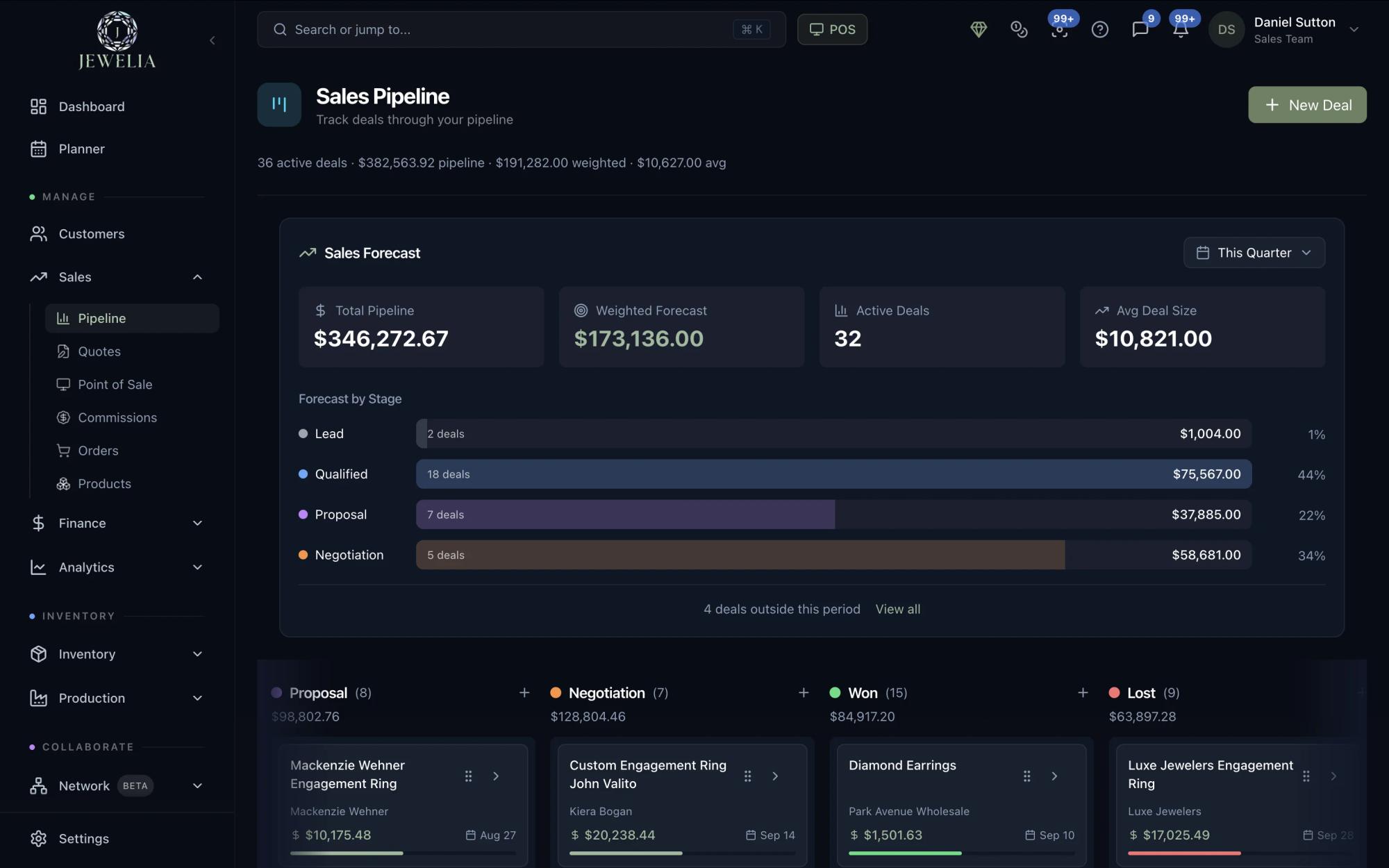
Drag deals across your own stages and see value by stage, weighted forecast, expected close and who owns each one — so a busy month is a number rather than a feeling.
Quote from live stock
Build the quote from inventory you actually hold, watch it go from sent to viewed to accepted, then convert it to an invoice and take the deposit without re-keying a line.
Customers, fully known
Purchases, repairs, memos, ring sizes, anniversaries, wishlists, calls and notes on one record — the clienteling detail that turns a walk-in into a client.
Nothing slips
Every deal and customer carries follow-up tasks with an owner and a due date, and occasions send a reminder before the date instead of after it.
The client record
Walk back to the counter already knowing.
Clienteling in a jewelry store is not a loyalty program. It is one salesperson remembering that this client buys for an anniversary in March, wears a size 6, has a repair with you right now, and mentioned a tennis bracelet in June. When that lives in one person’s head, it leaves when they do.
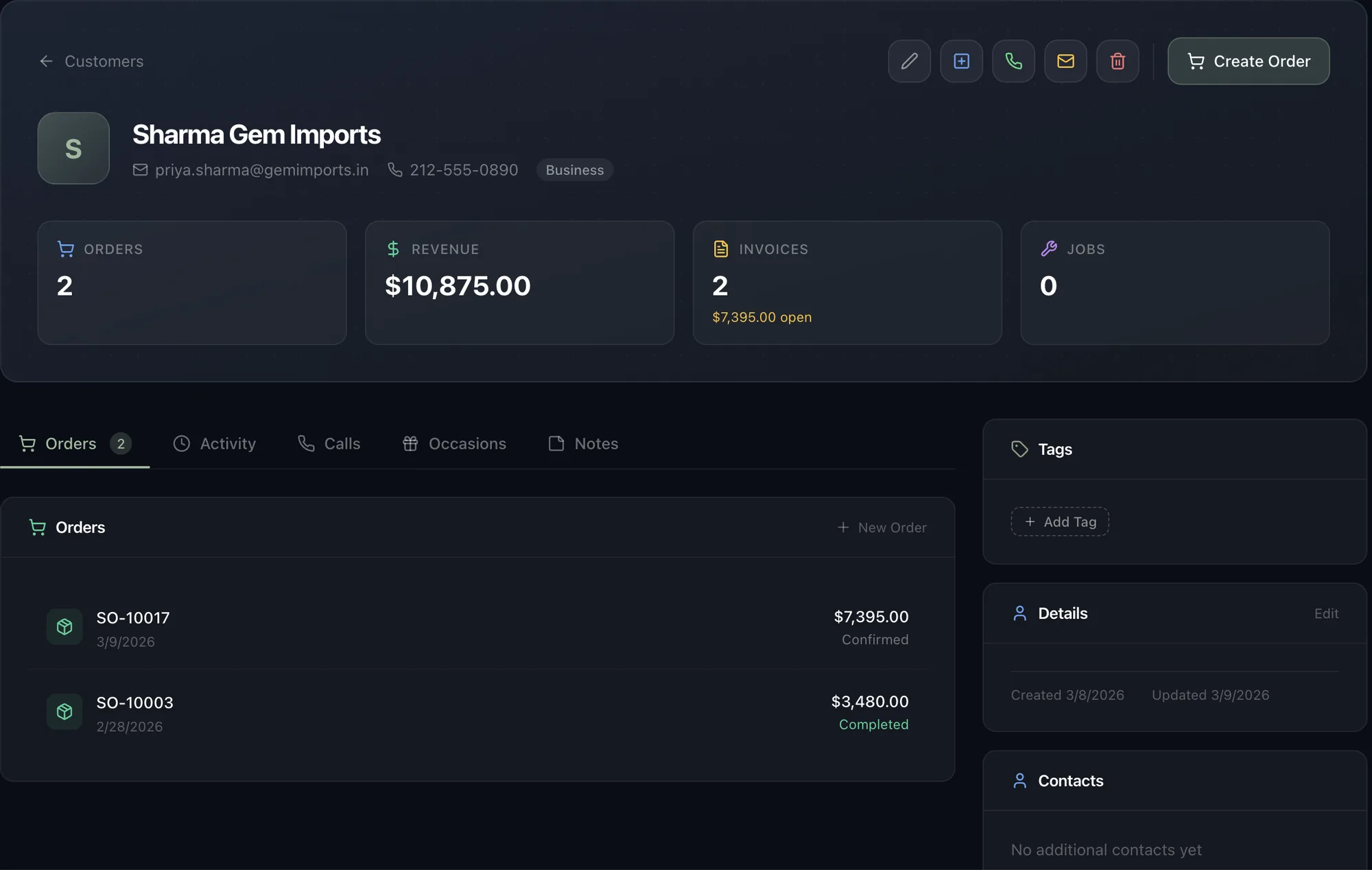
- Everything they have bought
- Orders, revenue, open invoices and jobs on the header, with the full purchase history underneath — not a summary someone typed up.
- Sizes and the details that sell
- Ring sizes, preferences and the notes that let the next person on shift continue the conversation rather than restart it.
- Occasions
- Birthdays, anniversaries and custom dates, with reminders before they land — which is the difference between a sale and a missed one.
- Wishlists
- What they want and when they want it, so an incoming parcel has a name attached before it reaches the case.
- Calls and notes
- Logged calls and notes attached to the record, so context belongs to the business rather than to one person's phone.
- Repairs, memos and appraisals
- The service history, the goods on memo and the insurance, sale or estate valuations — all on the same client, all printable.
A bridal sale takes six weeks. Track it like it does.
High-value jewelry is not an impulse purchase. An engagement ring, a custom piece or a wholesale order involves several visits and a decision made somewhere else — which is exactly the kind of sale that disappears without a pipeline.
Your stages, not ours
Lead, qualified, proposal, negotiation, won and lost by default — renamed and reordered to match how you actually sell.
Value by stage
What each stage is worth and how many deals sit in it, so a thin proposal column is visible weeks before it becomes a thin month.
Weighted forecast
The pipeline adjusted by probability, which is the number worth planning stock and cash against.
Average deal size & close date
Measured from deals that actually closed, with an expected close date on every card.
You can see when they opened it
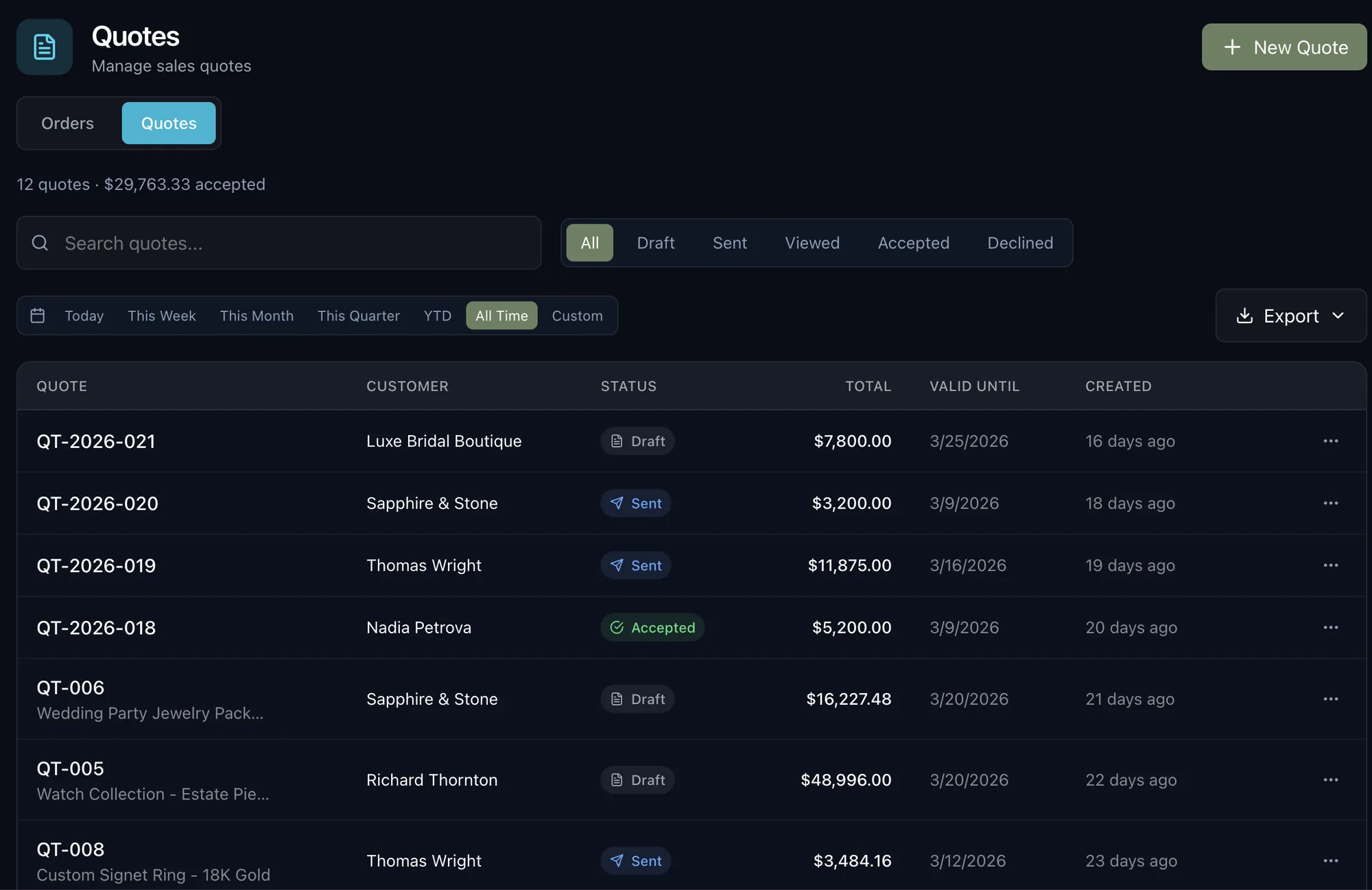
Most quotes are sent into silence. Here a quote has a status and an expiry, so the follow-up call happens on the day it is worth making rather than a week after the client bought elsewhere.
Draft
Built from live inventory with the pieces, prices and terms you intend to offer.
Sent
Out to the client with a valid-until date, so the offer has an expiry rather than an open end.
Viewed
You can see they opened it — which is the moment a follow-up call is worth making.
Accepted
One click to an invoice, with the deposit taken and the balance tracked on the record.
Declined
Logged rather than deleted, so lost quotes become win/loss data instead of disappearing.
And then getting paid
- Shareable invoice linksSend a link; the client views the invoice and pays online, and the payment lands straight on the record.
- Deposits and balancesCustom, special and stock orders carry status, deposit taken and balance due — the way jewelry money actually arrives.
- One payment, many invoicesApply a single payment across several open invoices at once instead of splitting it by hand.
- Store creditCredit from trade-ins, returns or goodwill, tracked per client and applied automatically to the next purchase.
Why not HubSpot or Salesforce?
Four things a general CRM cannot do for a jeweler
They are excellent products. They were built for software sales teams, and it shows the moment a customer hands you a ring across the counter.
It has never heard of a memo
A general CRM understands companies, contacts and deals. It has no concept of goods out on consignment, a special order with a deposit, a repair taken in at the counter or a stone that came in on memo — which is most of what a jewelry business actually tracks.
It cannot see your inventory
Quoting in a generic CRM means typing the piece in by hand from another system, and hoping it is still there when the customer says yes. Jewelia quotes from live stock, so the quote and the item are the same record.
The purchase history lives somewhere else
Your POS knows what they bought. Your CRM knows what you talked about. Neither knows both, so the salesperson greeting a returning client has half the picture and no idea which half is missing.
It is priced for a sales team, not a store
Per-seat enterprise CRM pricing assumes a room full of reps who live in the tool. A jewelry business needs every person on the floor to have access, which is why the CRM is included in the Jewelia plan rather than charged per seat.
One database
The CRM is not a separate app you keep in sync
It reads and writes the same records as inventory, POS, production and memo — which is why a quote can only offer stock you hold, and a counter sale appears on the client record before the customer reaches the door.
Inventory
Quotes and orders are built from stock you actually hold, so nothing is promised twice.
Point of Sale
A counter sale lands on the customer record as it is charged, completing the purchase history.
Production & Repairs
Custom jobs and repairs hang off the client, so service history and sales history are one story.
Planner
Follow-ups and appointments from a deal become tasks with an owner and a due date.
Memo & Ledger
Goods out with a client and the balance they owe sit on the same record as the relationship.
Jewelia AI
Ask who has not bought in six months, or have it draft the follow-up, from your own live data.
Pricing
Included in the plan, not billed per seat
Every plan includes the pipeline, quoting and client records — along with inventory, production, memo and the rest of the platform. There is no per-seat CRM charge, because everyone on the floor needs the client record.
Starter
$179/month
$149/month billed annually
500 customers
1 seat
- Visual sales pipeline & products
- Quotes, orders and invoicing
- Party ledger per customer
- Planner follow-up tasks
- 11 essential reports
Professional
$399/month
$333/month billed annually
5,000 customers
5 seats, role-based permissions
- Everything in Starter
- Jewelia AI — 250 credits/mo
- QuickBooks & eBay integrations
- 29 reports + custom report builder
- Advanced analytics
Enterprise
$999/month
$833/month billed annually
25,000 customers
10 seats (+$50/mo each)
- Everything in Professional
- Point of Sale & Stripe Connect
- Custom roles & audit logging
- All reports — compliance, multi-location, CLV
- 2,000 AI credits/mo
Jewelry CRM: questions
What is a jewelry CRM?
A jewelry CRM is customer relationship management software built for how jewelers sell: customer records that carry purchase history, repairs, memos, ring sizes, anniversaries and wishlists rather than just contact details, quotes built from live inventory, and a sales pipeline for custom and high-value pieces that take weeks to close. A general CRM tracks conversations about deals; a jewelry CRM tracks the pieces, the service history and the money as well, because in this trade those are the same relationship.
How is Jewelia different from HubSpot or Salesforce?
Generic CRMs do not know what a memo, a special order, a repair intake or a GIA certificate is, and they do not connect to your inventory or POS. In Jewelia the CRM records link directly to the items you sell, the repairs you take in and the memos you send out, so a quote is built from stock you actually hold and a counter sale appears on the customer record as it is charged. They are excellent tools for a software sales team. For a jewelry business they leave the hardest half of the job to a spreadsheet.
Does the CRM include a sales pipeline?
Yes. A visual pipeline with your own stages, showing value and deal count by stage, a weighted forecast based on probability, average deal size, expected close date and the owner of each deal. Pipeline analytics adds win rate, average days to close and a lead-to-won conversion funnel, so you can see which stage is losing deals rather than guessing.
Can I create quotes and turn them into invoices?
Yes. Quotes are built from live inventory and move through draft, sent, viewed, accepted and declined with a valid-until date on each one — so you know when a client has opened a quote and when an offer expires. An accepted quote converts to an invoice in one click, with the deposit taken and the balance tracked on the same record. Nothing is re-entered.
What does a customer profile hold?
Purchase history, orders, revenue, open invoices and jobs, plus ring sizes, preferences and notes, occasions such as birthdays and anniversaries with reminders, wishlists, logged calls and notes, repairs, goods out on memo, and appraisals for insurance, sale or estate value. It is the clienteling record a jewelry salesperson needs before they walk back to a returning client.
Does it support clienteling and wishlists?
Yes. Wishlists record what a client wants and when, occasions carry reminders that fire before the date rather than after it, and Jewelia AI can prompt you a month ahead. Combined with a full purchase history, that is what lets a store sell to the same client three times rather than once.
Can I import my existing customer list?
Yes, and you choose who does the work. The import wizard is self-serve on every plan, or send us your export from whatever you run today and we will load and clean it for you as part of onboarding — also on every plan. Duplicate detection and merge then cleans up the same client entered twice, keeping the history from both records.
Is Jewelia's CRM cloud-based?
Yes. It runs in a browser, so there is no server to maintain and no install on each machine, and your pipeline and client records are the same on the shop floor, at a trade show, and at home on a Sunday night.
Does it work for wholesalers and manufacturers, not just retail stores?
Yes. The same pipeline, quoting and account records serve a wholesaler selling to hundreds of retail accounts — with business customers, contacts, memo positions and balances — as well as a retailer selling to individuals. The difference is which fields matter, not which product you buy.
How much does the jewelry CRM cost?
It is included in every plan rather than sold separately or per seat. Starter is $179/month with 500 customers, Professional $399/month with 5,000, and Enterprise $999/month with 25,000. Annual billing saves about 17%.
See the pipeline on your own customers.
30-day money-back guarantee. Cancel any month, no setup fees.