
The buyer who wanted it never knew you had it.
Price lists in email, inquiries on WhatsApp, consignment in a notebook. Jewelry supply software that fixes all three. Put the stock, the prices and the buyers in one place — and give the buyers you choose a live view of what you have.
Jewelia for suppliers
Supply runs on being reachable
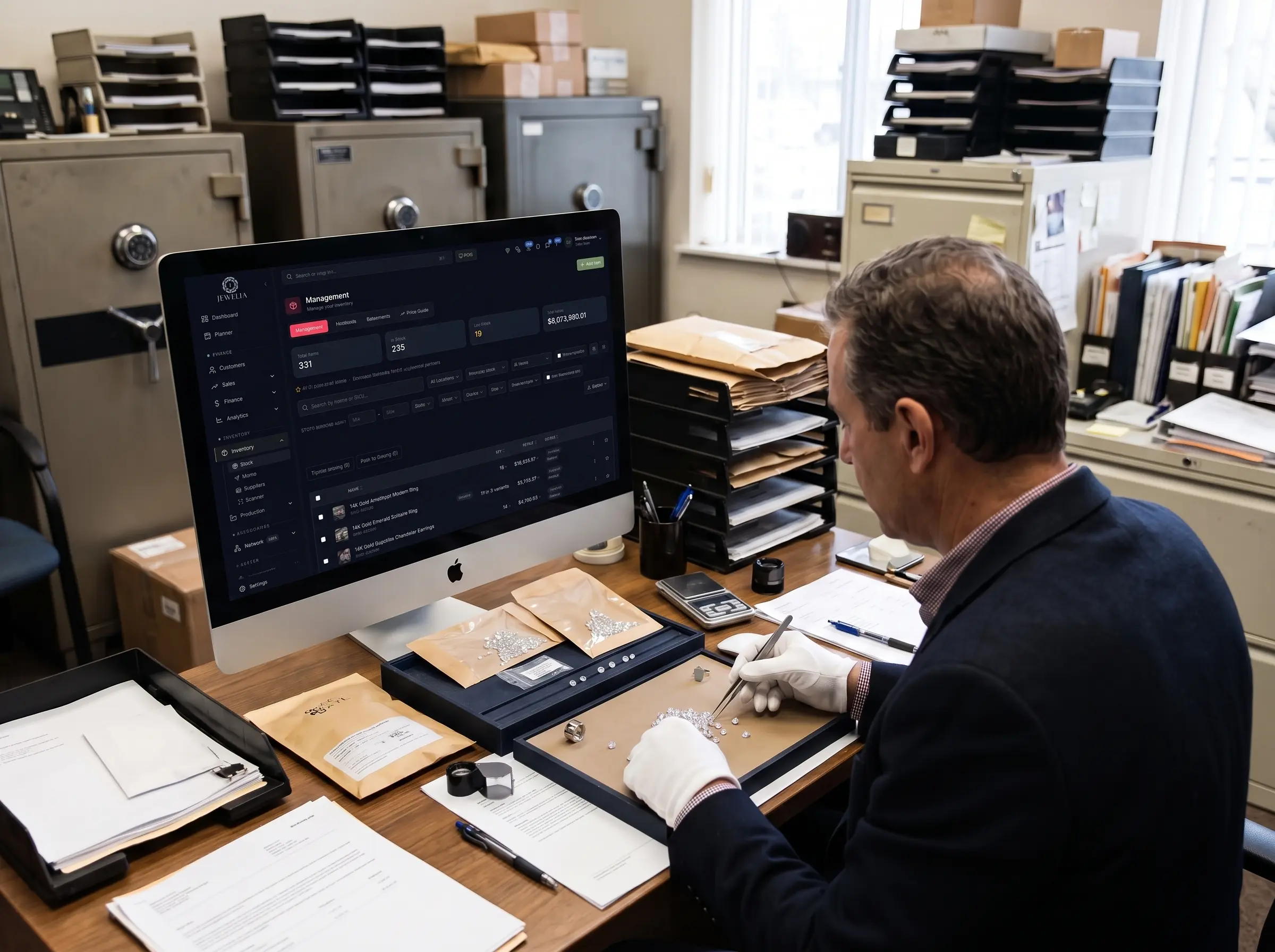
A jewelry supplier’s problem is rarely the goods. It is that the buyer who needed exactly that parcel on Tuesday had no way of knowing it existed, and by the time the price list reached them it was three months old. For jewelry suppliers of stones, metals, findings and tools, Jewelia handles bulk stock, account pricing and memo, and gives the retailers and manufacturers you choose a read-only view of the stock you have now.
The price list lives in an email
What it costs youBy the time it reaches the buyer it is three months old, and the quote they act on is not the price you meant.
How Jewelia solves itBulk upload, bulk repricing and account pricing, so every buyer sees the current price for their account.See how
The inquiry arrives on WhatsApp
What it costs youA photo, a question, a reply from memory. Nothing lands on a record and the follow-up depends on who saw the message.
How Jewelia solves itQuotes and orders built on the account record at that buyer's price tier, so nothing lives only in a WhatsApp thread.See how
The goods are out and nobody is sure where
What it costs youConsignment parcels with stockists, some sold, some returned, some forgotten. The reconciliation is a phone call.
How Jewelia solves itMemo out with terms, due dates, partial returns and 30/60/90 aging on a netted shared Ledger per counterparty.See how
The buyers who needed it never saw it
What it costs youThe manufacturer who needed exactly that parcel on Tuesday had no way of knowing it existed.
How Jewelia solves itA read-only Partner Portal showing the buyers you choose the stock you have now, at their price.See how
A list, not a catalogue
What it costs youA spreadsheet of SKUs with no grading, no certificate and no photo. Buyers cannot search it, so they do not.
How Jewelia solves itStone grading search, certificates and metal specifications on every item, so buyers find the parcel by what it is.See how
Your stock, in front of buyers
Give the buyers you choose a read-only Partner Portal view of selected stones, metals and findings — with price controlled per account rather than one list sent to everyone.
The right price, automatically
Account-specific tiers applied to quotes and memos as they are built, so nobody has to remember which buyer is on which terms.
Consignment that reconciles
Goods held by every stockist tracked line by line, with aging, partial returns and sold-with-price — and a shared statement that ends the settlement argument.
A catalogue, not a list
Bulk upload, bulk reprice and bulk edit thousands of items at once, because a supplier's stock arrives as a file and changes with the market.
Four places a supplier’s business leaks
None of these are dramatic. They are the ordinary friction of selling goods to businesses using email, a phone and a spreadsheet.
The price list lives in an email
A PDF sent in March, opened in July, quoted from in September. Every buyer has a different version and none of them are the one you would quote today.
The inquiry arrives on WhatsApp
A photo, a question, a number — in a thread with no record of what was offered, at what price, to whom. Then it is retyped into a quote, and retyped again into an invoice.
The goods are out and nobody is sure where
Parcels placed with stockists on memo, tracked in a notebook or a spreadsheet, reconciled from memory at the point where somebody has to concede.
The buyers who needed it never saw it
Trade shows and word of mouth reach the people already in the room. The parcel you cannot move is often one the right buyer never knew existed.
Not a marketplace. A shop window you control.
Nobody takes a cut, nobody stands between you and the jewelry buyer, and nothing is visible that you did not choose. You pick the items, the buyers and the price per account — and what they see is your live stock rather than a price list going stale.
- You choose the itemsShow only what you want seen. Everything else stays private to your business, and there is no setting that exposes the whole book by accident.
- You choose the buyersOnly the partners you invite to the Partner Portal see anything — businesses you already trade with, not the open internet.
- You choose the priceAccount price tiers mean the same item can show a different number to different buyers, applied automatically.
- They see live stockWhat a buyer sees is your inventory filtered to what you chose, so a parcel that sells stops being on offer without you updating a list.
- Line sheets for everyone elseBuild a line sheet from current stock at each account's price for buyers who are not on the portal.
- Room for your regulars10 partners on Professional, 50 on Enterprise — each with their own read-only view instead of a monthly email.
A buyer asks in carats, not SKUs
This is the point where general B2B and wholesale software stops being useful to a jewelry supplier selling stones or metal.
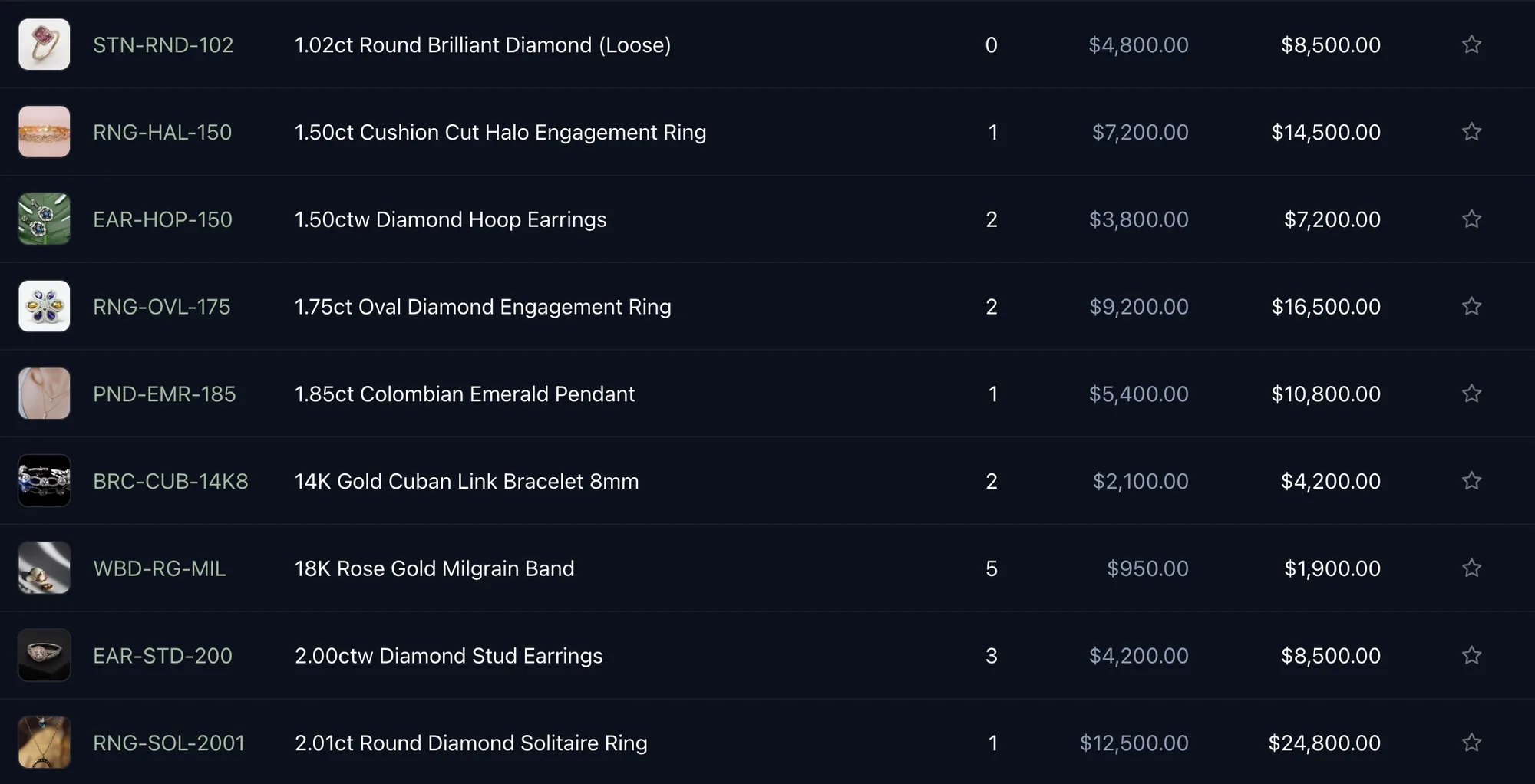
Stone grading search
Carat range, colour, clarity, shape, cut and fluorescence as filters, with a graded-stones-only option — so a buyer's request is answered from your parcels in seconds.
Certificates
GIA lookup by report number pulls grading onto the item; AGS and other certificates attach as documents so the paper travels with the stone.
Metal specifications
Type, karat, weight and fineness on every item, so findings and metals are priced and reordered on real figures.
Recall what hasn’t moved. Bill what has.
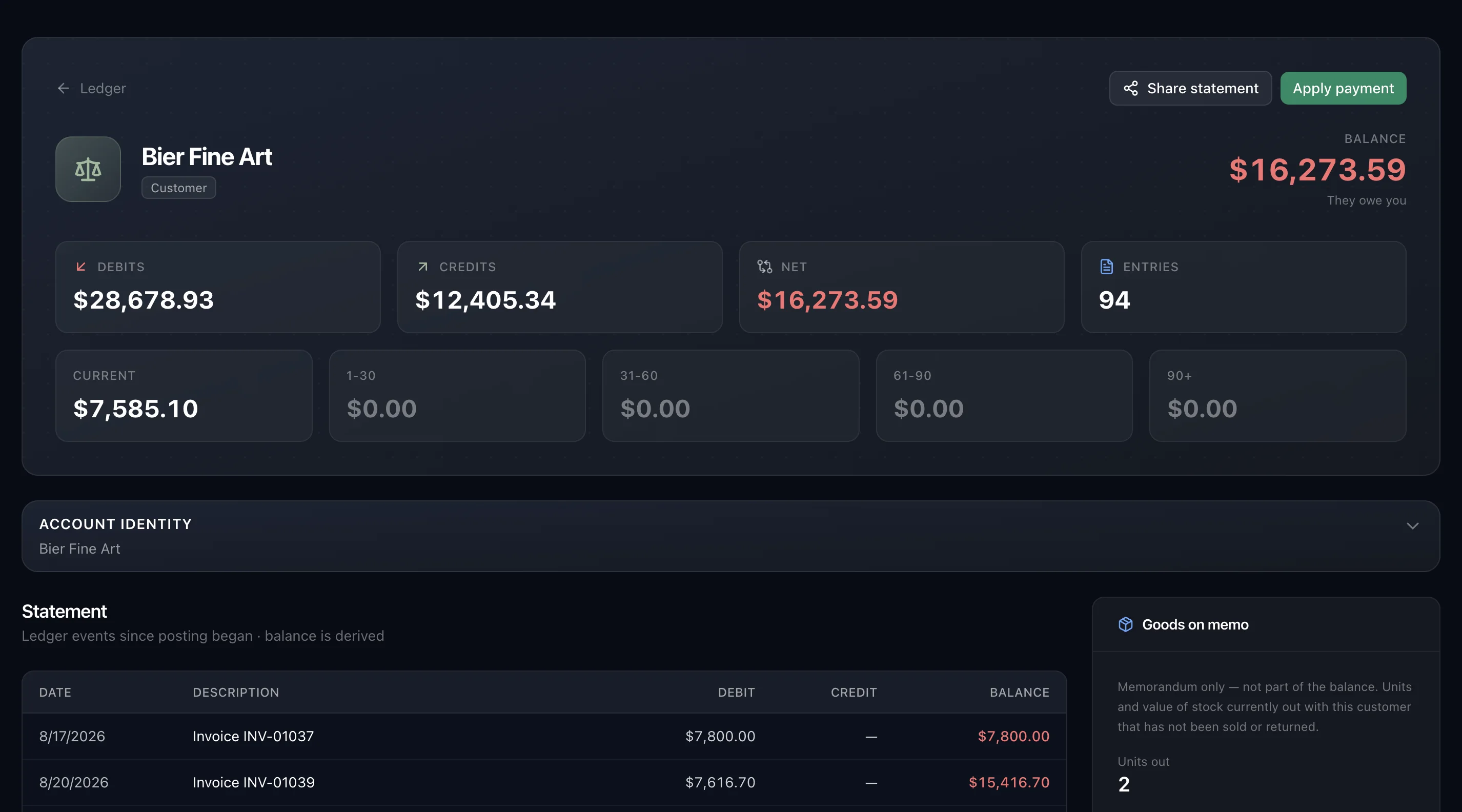
Goods held by every stockist, tracked line by line with aging and overdue counts. Sold lines convert to invoices in one click; the rest can be recalled before it becomes a conversation. And the balance sits on a statement the buyer can open, so settlement stops being two versions of the same history.
- Partial returns and sold-with-price, per line
- Confirmation by link — no account needed on their side
- Discrepancies logged on the memo, not recalled in a phone call
Different goods, the same problem
Stone & diamond dealers
Parcels searchable by the 4Cs, certificates attached by report number, goods out on memo to dozens of accounts, and aged balances visible per counterparty.
Metal & findings suppliers
A catalogue in the thousands that reprices with the market — bulk edit, account tiers, and buyers who can see current availability rather than a stale PDF.
Tool & equipment suppliers
Stock visible to the workshops you supply through the Partner Portal, with orders and quotes recorded against the account rather than in an inbox.
The parcel, the buyer and the balance are one record
Integrations
QuickBooks or Xero for the books, Shopify if you also sell online, and GIA lookup on every stone.
Inventory
Bulk upload and repricing, stone grading search, certificates and metal specifications.
Memo & Ledger
Consignment out to stockists, aging by counterparty, and a netted balance with a shareable statement.
Sales & CRM
Accounts with their price tier, quotes, orders and the history behind the relationship.
Analytics
What sells, who buys and where the growth is — by account, line and month.
Jewelia AI
Ask which lines are slow, who has not ordered in six months, or what is overdue on memo.
Every tool, one plan
Inventory, account pricing, memo and the ledger come in one subscription from $179/month, with a 30-day money-back guarantee.
Starter
Selling, and goods out on memo
$179/month
- 1,000 items · share 25
- Memo out with aging & PDFs
- Party ledger per account
- Quotes, orders and invoicing
Professional
A working supplier
$399/month
- 10,000 items · share 100
- Memo in + memo analytics
- Partner Portal — 10 partners
- GIA lookup · 29 reports
Enterprise
A full trading desk
$999/month
- 50,000 items · share 1,000
- Partner Portal — 50 partners
- All reports & API access
Software for jewelry suppliers: questions
What is software for jewelry suppliers?
Software for jewelry suppliers manages a large catalogue of stones, metals, findings or tools sold to other businesses: bulk inventory upload and repricing, account-specific price tiers, goods placed with buyers on memo or consignment, a ledger per account, and a way for buyers to see what is available. What separates it from general B2B or wholesale software is the trade data — stones searchable by the 4Cs, certificates by report number, metal karat and fineness — and memo, because a supplier's stock spends much of its life in someone else's safe while still being the supplier's asset.
Is this a marketplace?
No. Nothing is published to the open internet or to strangers. You choose which buyers see your stock through the Partner Portal, which items they see and at what price, and orders and memos happen directly between you and them — there is no intermediary taking a cut of the transaction or standing between you and the relationship.
Who can see my stock and my prices?
Only the partners you invite, only the items you choose, and at the price tier you set for each account. Everything else stays private to your organisation, and there is no setting that publishes it by accident.
Can I set different prices for different buyers?
Yes. Account-specific price tiers are applied automatically to quotes and memos, so a long-standing stockist and a new account can see different numbers for the same item without anyone having to remember which is which.
Can I upload and reprice thousands of items at once?
Yes. Bulk upload, bulk pricing and bulk edit are built for catalogues that arrive as a file and change with the market rather than item by item. Starter includes 1,000 items, Professional 10,000, Enterprise 50,000, and Enterprise Plus is unlimited.
Can buyers search my parcels by the 4Cs?
Stone grading filters cover carat range, colour, clarity, shape, cut and fluorescence, with a graded-stones-only option. That means when a buyer asks for 0.90 to 1.20, G or better, VS2 or better, the answer comes out of your own goods in seconds rather than from a parcel book and a phone call.
How does consignment tracking work?
Goods placed with a stockist go out on memo with terms, a due date and a PDF document. Every line is tracked independently — still out, returned, or sold at the price it actually went for — with 30/60/90 aging and overdue counts per counterparty. A sold line converts to an invoice in one click, and the balance moves on a ledger the buyer can also open.
Do my buyers need an account to confirm a delivery?
No. Confirmation goes out as a link: the other side ticks off what actually arrived line by line and can attach photos, without creating an account. If what arrived differs from what was sent, the discrepancy is logged against the memo and resolved there rather than in a phone call neither side can produce later.
Does it handle certificates and diamond price guides?
GIA certificate lookup by report number is included, and certificates from other labs attach to the item as documents. A Rapaport price guide integration is on the roadmap rather than in the product today, so pricing and quoting run on your own cost and asking figures.
What does it cost?
There is no free tier — plans start at $179/month on Starter, which includes memo out and the Ledger; Professional at $399/month adds memo in, the Partner Portal and certificate lookup; Enterprise at $999/month adds a 50-partner Portal and API access. Annual billing saves about 17%.
Put your stock where buyers are looking.
30-day money-back guarantee. Cancel any month, no setup fees.