
Your stock lives in other people’s safes.
Thousands of SKUs, dozens of accounts, goods out on memo everywhere. Wholesale jewelry software that shows what’s out, what’s due back and who owes what — and puts your line in front of retailers who are already working in it.

Jewelia for wholesalers
An asset you own and cannot see
Most of what a wholesaler owns is somewhere else — in a case three states away, in a rep’s bag, at a show. It is still your stock and still your money, and the only thing standing between you and it is a record somebody kept properly. For jewelry wholesalers, Jewelia is wholesale jewelry software built around memo: goods go out with terms and come back tracked, and the Ledger nets what is owed both ways with each account.
Goods you can't account for
What it costs youPieces in a case three states away, in a rep's bag, at a show. It is still your stock and your money, and nobody can say exactly what is where.
How Jewelia solves itMemo out tracked line by line with terms and due dates, so what is out, with whom, and since when is one screen rather than a guess.See how
Partial returns that never reconcile
What it costs youTwelve pieces go out, seven come back, two sold at a different price. The paperwork never quite adds up and someone eats the difference.
How Jewelia solves itPartial returns and sold-with-price on the same memo, and a sold memo converts to an invoice in one click.See how
Two ledgers that disagree
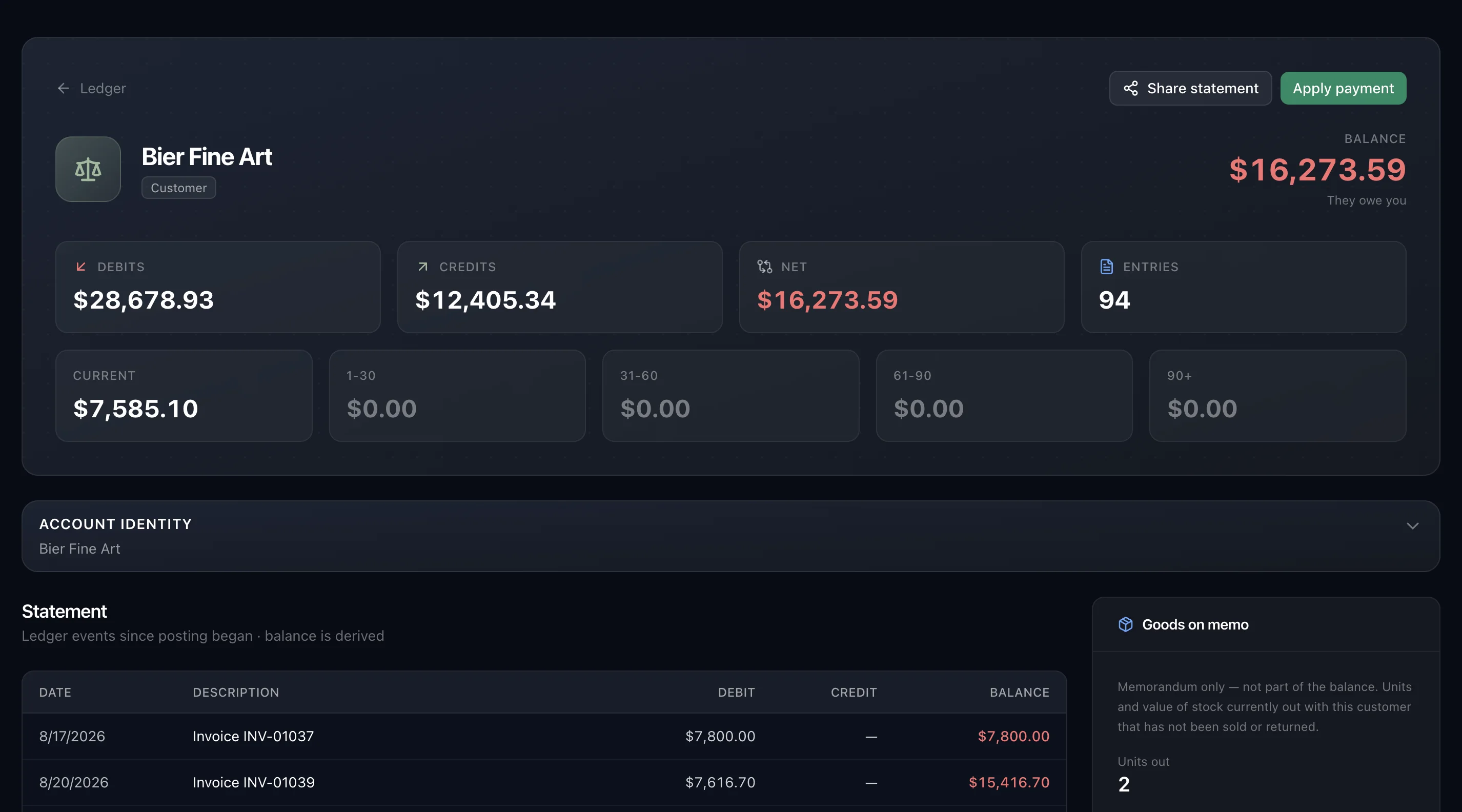
What it costs youYour spreadsheet says they owe $18,400; theirs says $14,200. The relationship pays for the gap.
How Jewelia solves itThe Ledger nets what is owed both ways per account, with an optional live statement you can share, so a disagreement is settled on one shared screen.See how
Chasing before it's awkward
What it costs youMemo past 60 days that nobody noticed until it was past 120, and a call that now has to be a difficult one.
How Jewelia solves it30/60/90 aging on every account, and Jewelia AI drafts the recall notes for you to approve.See how
Stock nobody knows you have
What it costs youThe retailer who needed exactly that line last week had no idea it existed, and your rep visits once a quarter.
How Jewelia solves itLine sheets built from live stock at each account's price, and a read-only Partner Portal for the accounts you choose.See how
Know what's out, to the line
Every piece placed with a stockist carries terms, a due date and a PDF — so consigned goods are a tracked position rather than a memory and a WhatsApp thread.
Chase before it's awkward
30/60/90-day aging and overdue counts by stockist, with reminders that go out before the due date rather than three months after it.
One balance, not two
A netted ledger per account, with an optional live statement link you can send the retailer — which is what ends the annual argument about what was actually paid. Sharing is your call, account by account.
Let retailers find you
Share selected stock with stores already running on Jewelia, and give dropshippers a read-only Partner Portal instead of emailing a PDF catalogue every month.
How much of your stock is in someone else’s safe?
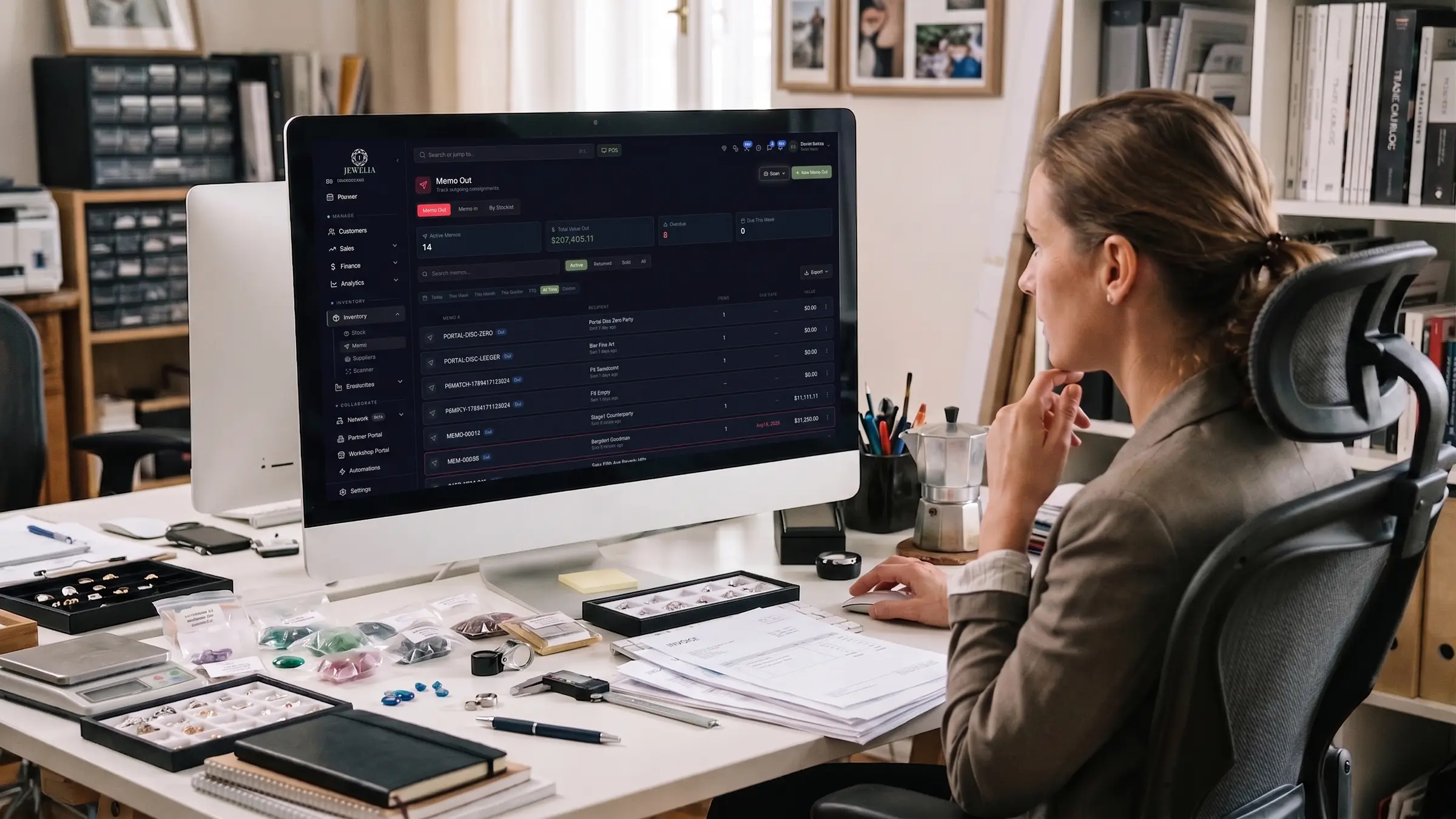
Most wholesalers cannot answer that to the dollar without a phone call and an afternoon. Memo Out shows active memos, the total value currently out and the overdue count on one screen — then lets you open any of it by stockist, by due date or by what is late.
- Total value out, live — not reconstructed at month end
- Overdue count front and centre, because that is the money at risk
- Filter by stockist, period or status, then export the position
Four places a wholesaler quietly loses money
None of these feel like losses at the time. They feel like admin, or like a difficult customer, or like a slow season.
Goods you can't account for
Memo run on paper and messages means nobody can answer “who has what, since when” without ringing round. The pieces are not lost exactly — they are just unaccounted for, which on a balance sheet is the same thing.
Partial returns that never reconcile
Three go out, two come back, one sells. A spreadsheet row for the whole shipment cannot hold that, so the settlement conversation happens from memory and somebody concedes.
Two ledgers that disagree
You keep yours, the retailer keeps theirs, and payment proof lives in a text thread. The gap is rarely fraud and almost always drift — but it is written off at your end.
Stock nobody knows you have
Trade shows and word of mouth only reach the people in the room. The line you can't move is often just a line the right buyer never saw.
Placed, aged, settled — on one record.
Memo is the whole job for a wholesaler, and it is the thing general wholesale and ERP software has no concept of. Here every line is tracked independently, and the money that follows sits on a ledger the retailer can open too.
- 1Place itSend items to a stockist, a partner store, a show or a rep on the road with terms, a due date and a PDF memo document.
- 2Track itEvery line tracked independently — still out, returned, or sold at the price it actually went for.
- 3Age it30/60/90 buckets and overdue counts per counterparty, so you chase the right account first rather than the loudest one.
- 4Confirm itThe other side ticks off what arrived line by line, with photos, from a link — no account needed, and a record afterwards.
- 5Bill itOne click from memo to invoice when a piece sells. The ledger balance moves and nothing is re-keyed.
Built for a catalogue, not a shop floor
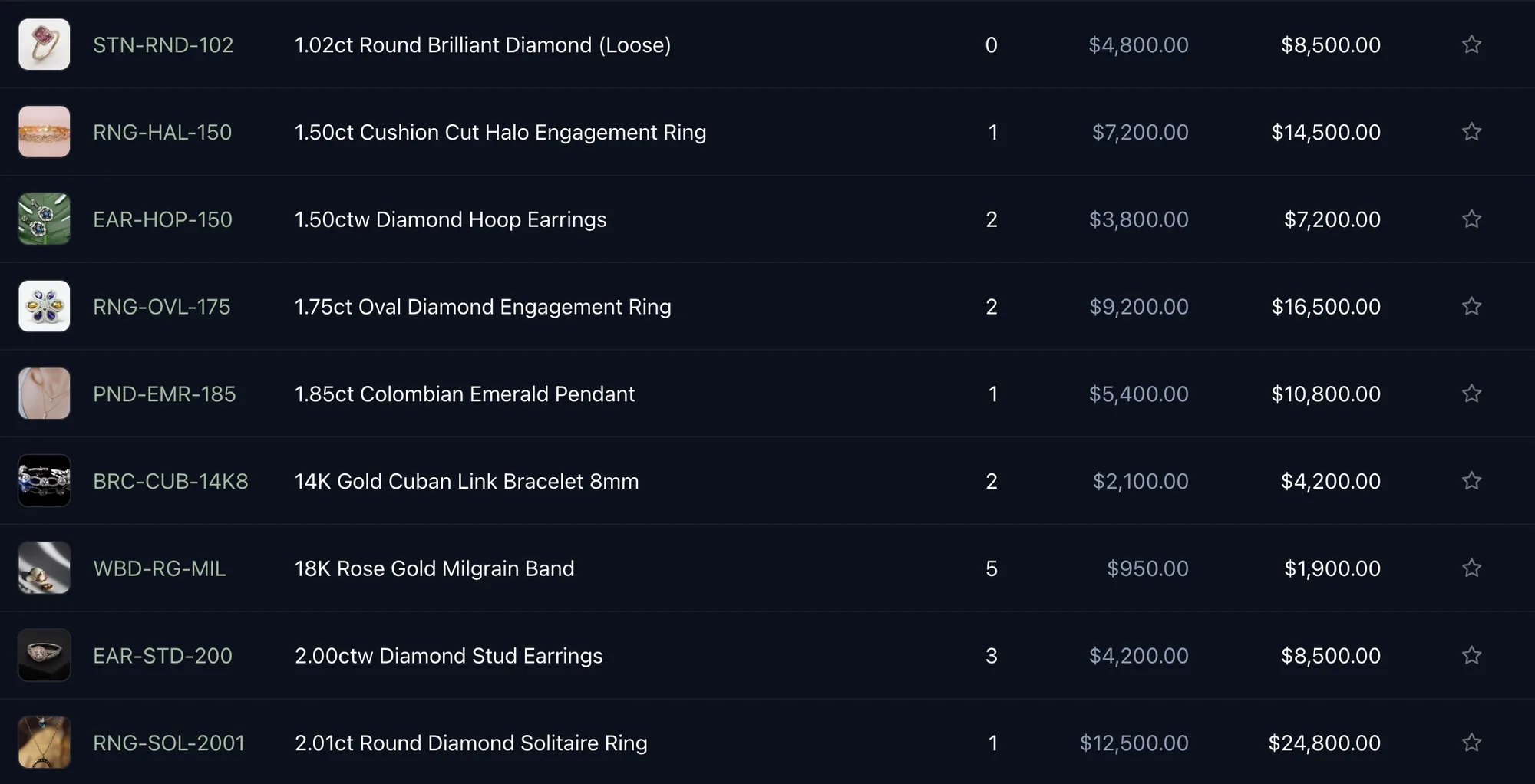
A wholesaler’s stock arrives as a file, prices differently for every account, and gets searched the way a buyer asks for goods.
Bulk inventory tools
Upload thousands of items at once, bulk price, bulk edit and barcode everything — because a wholesaler's catalogue does not get built one item at a time.
Customer-specific pricing
Price tiers per account, applied automatically to quotes and memos, so the right number appears without anyone remembering which store gets which discount.
Stone grading search
Filter your own parcels by carat range, colour, clarity, shape, cut and fluorescence — the way a buyer asks for goods, rather than by SKU.
Sales by account & rep
Best sellers, slow movers and aged balances per account, in reports or by asking the AI in plain English.
Partner Portal
A read-only view of the stock you have shared, for dropshippers and stockists — 10 partners on Professional, 50 on Enterprise.
Line sheets from live stock
Build a line sheet from current inventory, with images and each account's price, instead of a PDF that is out of date by the time it is opened.
Trade shows only reach the room.
The line you cannot move is often just a line the right buyer never saw. Give your best accounts a read-only Partner Portal with the stock you choose, at their price, and send everyone else a line sheet built from what you have today.
- They see live stock, so a sold piece stops being on offer
- Each account sees its own price tier, applied automatically
- 10 partners on Professional, 50 on Enterprise
“Wholesaler” covers a lot of ground
Diamond & stone dealers
Parcels out on memo to dozens of accounts, goods searchable by the 4Cs rather than by SKU, certificates attached by report number, and aged balances visible per counterparty.
Finished goods wholesalers
A catalogue in the thousands, price tiers by account, bulk upload and repricing, and stock shared with each stockist rather than one PDF sent to everybody.
Brands with stockists
Your line placed in stores you do not control, settled on a statement you can choose to share, with a Partner Portal instead of a monthly email of what is available.
The goods, the account and the balance are one record
Memo & Ledger
The core of the wholesale workflow — out, in, aging, partial returns and a netted balance per account.
Inventory
Bulk upload, stone grading search, certificates and locations — with memo goods tracked apart from stock you own.
Partner Portal
A read-only view of the stock you choose, for the retailers and dropshippers you invite.
Sales & CRM
Accounts with contacts, orders, quotes at their price tier, and the history behind the relationship.
Analytics
Sales by account and rep, memo aging by counterparty, and what is moving versus what is sitting.
Production
If you also make what you sell, runs and outwork sit on the same board as everything else.
Memo is not an add-on
Memo out and the shared Ledger are in the entry plan, because for a wholesaler they are not an optional module — they are the product.
Starter
Memo out, and the ledger
$179/month
$149/month billed annually
- Memo out with terms, aging & PDFs
- Party ledger per account
- 1,000 items · 500 customers
- Production — 25 active jobs
- 11 essential reports
Professional
Both directions, and a portal
$399/month
$333/month billed annually
- Everything in Starter
- Memo in + memo analytics
- 10,000 items · 5,000 customers
- Partner Portal — 10 partners
- Share 100 items · 29 reports
Enterprise
A full trading operation
$999/month
$833/month billed annually
- Everything in Professional
- 50,000 items · 200 locations
- Partner Portal — 50 partners
- Share 1,000 items · all reports
Wholesale jewelry software: questions
What is wholesale jewelry software?
Wholesale jewelry software runs the side of the trade that sells to other businesses rather than to the public: a large catalogue with bulk upload and repricing, account-specific price tiers, goods placed with stockists on memo, aging and settlement across dozens of accounts, and a ledger per counterparty. The distinguishing feature against general wholesale or ERP software is memo — because a wholesaler's stock spends much of its life in somebody else's safe while still being the wholesaler's asset.
How does memo tracking work in Jewelia?
You send items out on memo with terms and a due date, and a PDF memo document is generated. As items are returned, sold or extended you record it per line rather than per shipment, so three out, two back and one sold is a normal case instead of a reconciliation problem. Aging and overdue counts update automatically, and a sold memo converts to an invoice in one click. Memo in from your own suppliers works the same way.
Can my retailers see their balance?
Only if you want them to. Nothing is visible to a retailer until you send the link, and you can share with one account and not another. When you do share, they see the same netted balance, memo lines and applied payments that you do. It updates as entries post, so it is never a stale attachment — which is usually what ends the “we already paid for those” conversation for good.
Can I set different prices for different accounts?
Yes. Customer-specific price tiers are applied automatically to quotes and memos, so the right number appears for each account without anyone having to remember which store is on which terms.
Can I upload thousands of SKUs at once?
Yes. Bulk inventory upload, bulk pricing and bulk edit are built for catalogues that arrive as a file rather than item by item, and everything can be barcoded. Starter includes 1,000 items, Professional 10,000, Enterprise 50,000 and Enterprise Plus is unlimited.
Can I search parcels by the 4Cs?
Yes. Stone grading filters cover carat range, colour, clarity, shape, cut and fluorescence, with a graded-stones-only option — so when a buyer asks for 0.90 to 1.20, G or better, VS2 or better, you answer from your own goods in seconds rather than opening a parcel book.
Can retailers see my stock?
Only the ones you invite. The Partner Portal gives a retailer or dropshipper a read-only view of the items you choose, taken from your live inventory, so a piece that sells stops being on offer without anyone updating a list. Professional includes 10 partners and Enterprise 50.
What is the Partner Portal?
A read-only view of the inventory you have shared, given to a dropshipper or stockist so they can see what is available without an account on your system and without seeing anything you have not published. It covers 10 partners on Professional and 50 on Enterprise.
Does it integrate with RapNet or EDI?
EDI, yes — built per trading partner on Enterprise and above, so you can sell into the majors that require it. Tell us which retailers on the contact page and we scope it with you. RapNet listing and the Rapaport price guide are on the roadmap rather than shipped.
Does it handle memo in from my own suppliers?
Yes, on Professional and above. Most wholesalers sit in the middle of the chain — holding goods from dealers while placing goods with stores — and both directions run on the same ledger, so your net position with each counterparty is a single number.
How much does it cost?
Memo out and the Ledger are included on Starter at $179/month. Memo in with memo analytics is on Professional at $399/month, and Enterprise at $999/month adds a 50-partner Portal and the full report set. Annual billing saves about 17%, and pricing is published rather than quoted after a call.
See your own memo position in it.
30-day money-back guarantee. Cancel any month, no setup fees.