WhatsApp earned its place in the jewelry trade for good reasons. It's instant, everyone already has it, and you can fire off a photo of a finished piece to a client or a wax to your bench in seconds. If your business runs on it today, that's not a mistake — it's how a fast, relationship-driven industry actually moves.
But once your volume grows, the same tool that made you quick starts to quietly slow you down. The problem isn't WhatsApp. The problem is asking a messaging app to do the job of an operating system. Here's where that gap shows up, and what a purpose-built setup does differently.
Why WhatsApp works — until it doesn't
A single custom order can touch a client, a CAD designer, a caster, a setter, a polisher, and a stone supplier. On WhatsApp, that becomes five or six separate chats, each holding a piece of the truth. The ring size lives in one thread, the stone specs in another, the client's "actually, make it yellow gold" buried somewhere above a photo of someone's lunch.
Nothing is wrong with any single message. The issue is that the full picture of the order doesn't live anywhere. It lives in your head — and in your team's collective memory. That works right up until it doesn't.
The five things WhatsApp can't do for a jewelry business
1. It doesn't hold a record. A chat is a stream, not a database. You can't pull up "every open order for this client," "which pieces are at the setter right now," or "what did we quote on this three weeks ago" without scrolling. The information exists, but it isn't organized, so it isn't usable.
2. It doesn't track a job through production. When a piece moves from CAD to casting to setting to QC, WhatsApp has no idea. There's no status, no stage, no owner. If a job stalls at the polisher for a week, nothing flags it. You find out when the client calls asking where their ring is.
3. It doesn't survive people leaving. When a team member walks out the door, their chats — and the order history inside them — often walk with them. Client relationships and job context that took years to build sit trapped on a personal phone.
4. It doesn't connect to your inventory or pricing. Quote a piece over chat and you're pricing from memory or a side calculator. Metal moves daily; a number you gave on Monday can be wrong by Thursday. There's no link between the conversation and what the piece actually costs to make right now.
5. It doesn't scale past you. As the owner, you become the router. Every question flows through you because you're the only one who knows the whole picture. That's the real ceiling — the business can't grow past your personal bandwidth.
What "good" looks like instead
None of this means abandoning fast communication. It means giving every message a home — a system where the conversation is attached to the actual order, the actual client, and the actual production stage.
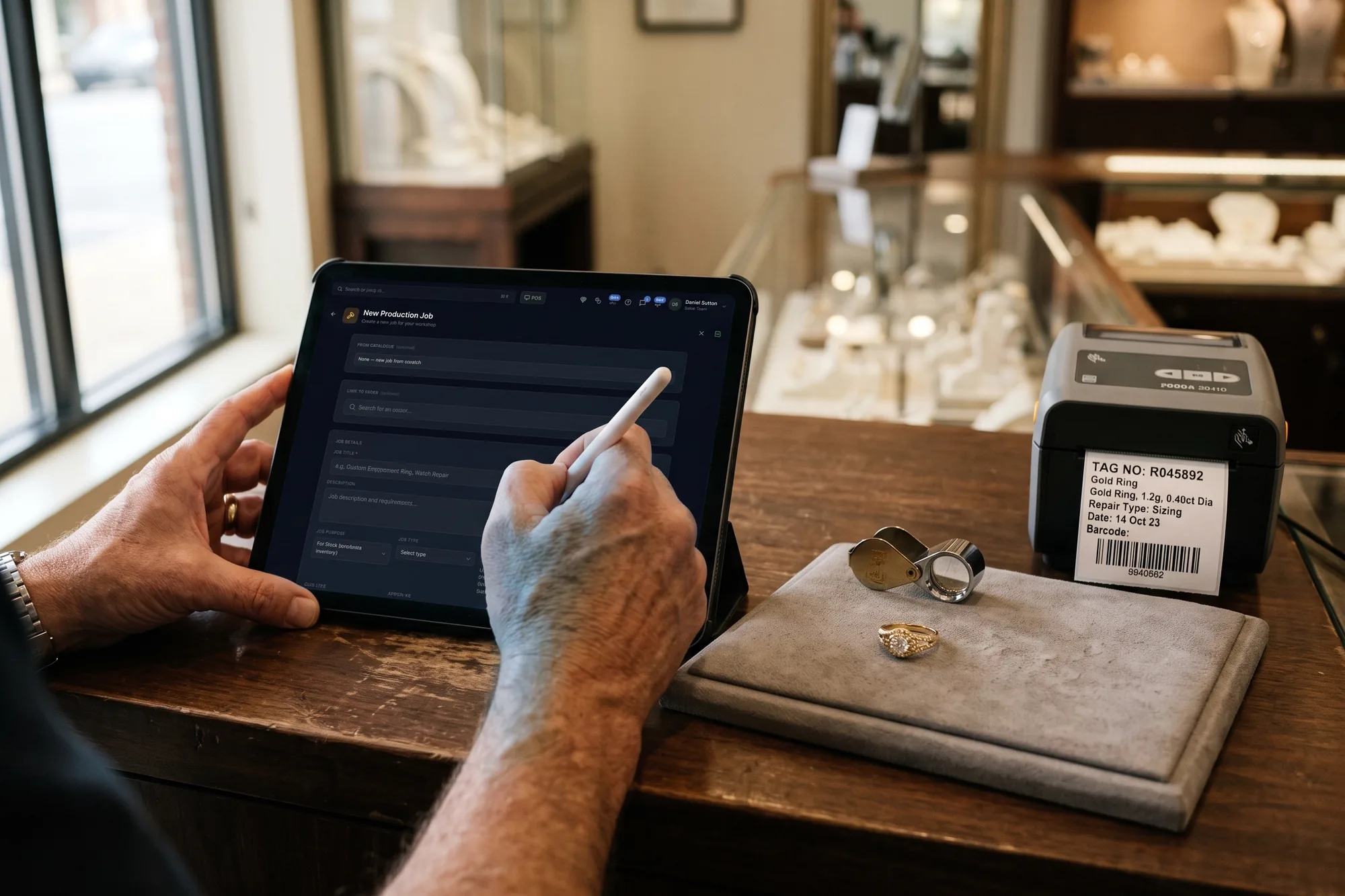
Picture the same custom order, but every detail lives on one record: the client's full history, the specs, the current production stage, who's holding it, the live cost based on today's metal price, and every note in one place. Your bench sees what they need. Your client gets accurate updates. And when someone asks "where's this order?", the answer is on the screen — not in someone's memory.
That's the shift from messaging about your business to running your business.
Making the move without the pain
You don't have to rip WhatsApp out overnight. The businesses that make this transition smoothly tend to:
- Start with orders, not everything. Move your custom-order and repair pipeline onto a single system first. That's where the dropped balls hurt most.
- Keep one source of truth for clients. A real CRM means the relationship isn't stuck on a phone. It's an asset the whole business owns.
- Connect pricing to the conversation. When quotes pull from live metal pricing and your actual inventory, you stop guessing and stop leaving money on the table.
- Let the fast channels stay fast. Use messaging for the quick back-and-forth — but let the record live in the system, not the chat.
Where Jewelia fits
WhatsApp made you fast. What it cannot give you is a memory, and that is the whole gap.
Jewelia is where the record lives once the conversation has done its job. The CRM holds the client with every order, repair, quote and appraisal against their name. Production & Repairs gives each job a stage, an owner, a due date and photos at each step, so "where is this?" is a glance rather than a scroll. Inventory carries the metal, stone and certificate detail a quote should be built from instead of estimated. And when a job changes stage, the client is notified automatically — which is most of what the chat was doing anyway.
The bottom line
WhatsApp made you fast. A purpose-built platform keeps you fast and gives you a memory, a record, and room to grow. Keep the messaging for the quick back-and-forth; move the truth somewhere it can be found.
See what your business looks like when every order has a home. Book a Jewelia demo →
Frequently asked questions
- Is WhatsApp bad for a jewelry business?
- No — it's a great communication tool. It just isn't an operating system. The trouble starts when it becomes the only place your orders, client history, and production status live, because a chat can't organize or track any of that.
- What should replace WhatsApp for jewelry order management?
- A purpose-built jewelry platform that combines CRM, order and production tracking, inventory, and pricing in one place — so the conversation is attached to the actual order rather than scattered across chats.
- Do I have to stop using WhatsApp entirely?
- No. Most businesses keep messaging for quick back-and-forth and move the *record* — orders, client history, production stages — into a dedicated system.
Stop reading, start clicking.
Open a live Jewelia company with real inventory, memo, jobs and reports already in it. One work email, no card, no sales call, nothing to install.