Every jeweler who runs custom or repair work has lived the same afternoon: a client calls to ask where their piece is, and you realize you're not entirely sure. Is it still with the setter? Did the casting come back? Was it waiting on a stone that never got ordered? The work itself was never the problem — your bench is skilled and your suppliers are good. The problem is that the job moved through five hands and nobody had a single, shared view of where it actually stood.
Production delays in jewelry rarely come from slow craftsmanship. They come from the gaps between steps — the handoffs, the waiting, the "I thought you had it" moments. This field guide walks through where those delays actually originate and gives you a practical way to shorten them, whether you're a two-person studio or a shop coordinating with outside casters, setters, and engravers.
Where delays actually come from
If you map a custom order from consultation to pickup, most of the calendar time isn't spent making anything. It's spent waiting and coordinating. The usual culprits:
- Handoff lag. A piece finishes one stage and sits because the next person doesn't know it's ready.
- Missing inputs. Casting can't start without the wax; setting can't start without the stones; nothing can start without an approved design.
- Unclear ownership. When a job stalls, no one is sure whose court the ball is in.
- Rework loops. A misread spec sends a piece back a stage or two, quietly eating days.
- External dependencies. Outside vendors — casters, plating houses, stone dealers — operate on their own clocks, and you find out about their delays late.
Notice that only one of these is about the actual bench work. The rest are coordination problems, which is good news: coordination is far more fixable than trying to make skilled hands move faster.
Make the invisible pipeline visible
You can't shorten a process you can't see. The single highest-leverage move is getting every active job onto one board where its current stage is obvious at a glance.
That doesn't mean a fancy system on day one. It means a shared, always-current answer to three questions for every open order:
- What stage is it in right now? (design, wax, casting, setting, polish, QC, ready)
- Who owns the next action?
- What is it waiting on, if anything?
When those three answers live in one place instead of in someone's head or a text thread, the "where is it?" phone call stops being a scramble. And the jobs that are quietly stuck become visible before a client has to point them out.
Tighten the handoffs
Delays cluster at the seams between stages. A few habits close those seams:
Define what "done" means for each stage. A piece isn't "cast" until it's cleaned, inspected, and flagged ready for the next hand. Ambiguity is where days disappear.
Batch and sequence deliberately. If your caster runs on Tuesdays and Fridays, waxes need to be ready the day before — not "sometime this week." Working backward from vendor schedules prevents a finished wax from missing the run by an hour.
Order long-lead inputs first. Stones, findings, and specialty materials should be sourced the moment a design is approved, not when the piece reaches the stage that needs them. A ring can't wait on a center stone that hasn't been ordered.
Manage the external chain, not just your bench
Here's the part most workflow advice skips: a large share of custom jewelry delays live outside your four walls. The caster, the setter you send stones to, the engraver, the plating house — each is a separate business with its own queue. When one of them slips, you often learn about it days later, and by then it's already on your critical path.
The shops that stay on schedule treat outside vendors as part of one production timeline rather than a series of black boxes. Practically:
- Log the promised turnaround for each external step so a missed date is obvious, not a surprise.
- Keep the piece's full spec attached to the job so the vendor never has to call back with questions (each question is a lost day).
- Confirm receipt and expected return at every send-out, so nothing goes silent in transit.
| Delay source | What it looks like | The fix |
|---|---|---|
| Handoff lag | Finished piece sits between stages | Shared stage-by-stage view of every job |
| Missing inputs | Casting/setting can't start | Order long-lead materials at design approval |
| Unclear ownership | Job stalls, no one notices | One named owner for the next action |
| External vendor slip | Learned about it too late | Log promised turnarounds; flag misses early |
| Rework loops | Piece bounces back a stage | Clear "done" definition and full spec per job |
Build a rhythm, not a fire drill
Reducing delays isn't a one-time cleanup; it's a light daily habit. A five-minute morning scan of every open job — what moved, what's stuck, what's due out to a vendor — catches problems while they're still small. The goal is to make the schedule something you steer, not something that surprises you.
Set gentle internal deadlines that sit ahead of what you promised the client. That buffer absorbs the inevitable vendor slip or rework loop without touching the delivery date the customer is counting on.
Where Jewelia fits
Most delays live in the gaps between steps — the hand-offs, the waiting, and the outside dependencies you learn about late.
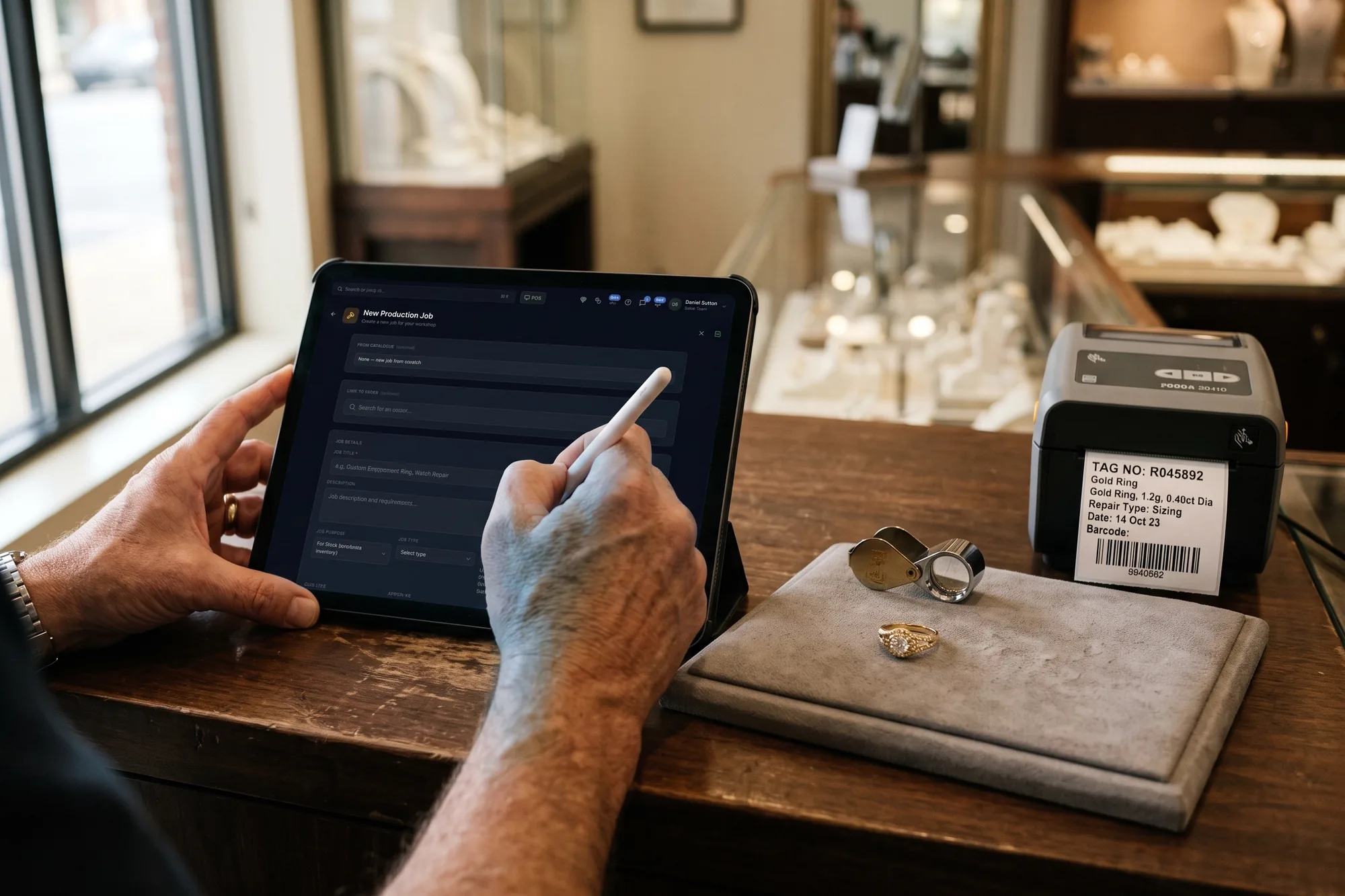
Jewelia closes those gaps with one production and repair workflow where every job shows its current stage, its owner and what it is waiting on, so a stalled job surfaces before a client has to ask. Stages are yours to define, photos and stage forms record what actually happened, and any stage sent to an outside caster, setter or plater keeps a due date on your board. Long-lead inputs come off inventory with low-stock alerts rather than being remembered, and the Planner turns the five-minute morning scan into a list of what is due out and due back today.
Bottom line
Jewelry production delays are coordination problems wearing a craftsmanship costume. Make every job's stage, owner, and blocker visible; tighten the handoffs; order long-lead inputs early; and treat outside vendors as part of one timeline. Do that consistently and the "where is my piece?" call becomes a thing of the past.
See how one workflow keeps every custom order moving. Book a Jewelia demo →
Frequently asked questions
- What causes most jewelry production delays?
- Most delays come from coordination gaps rather than slow bench work — handoffs between stages, missing materials, unclear ownership, and outside vendors slipping without warning.
- How do I reduce delays with outside casters and setters?
- Log each vendor's promised turnaround, attach the full spec to every send-out so they never have to call with questions, and confirm receipt and return dates so nothing goes silent.
- Do I need software to reduce production delays?
- Not to start — a single shared view of every job's stage, owner, and blocker helps immediately. Purpose-built software like Jewelia makes that view automatic and adds the external-vendor coordination that spreadsheets can't.
Stop reading, start clicking.
Open a live Jewelia company with real inventory, memo, jobs and reports already in it. One work email, no card, no sales call, nothing to install.