If you run a jewelry business, you already manage a supply chain, whether or not you call it that. Every engagement ring, every repair, every special order moves through a chain of people and steps before it reaches the person who will wear it. You coordinate that chain every day, often from memory and instinct, and the fact that it usually works is a testament to your skill.
This guide lays out how the jewelry supply chain actually operates, where the friction tends to build, and how the best operators keep pieces moving without losing sleep. It is written for jewelers who want a clearer mental model of the whole flow, from raw stone to finished piece, so they can spot the weak links before a customer ever notices them.
What "supply chain" means in jewelry
In most industries, a supply chain is a fairly linear thing: raw material in, finished product out. Jewelry is different. A single custom piece can pass through five or more independent vendors, a stone dealer, a casting house, a setter, an engraver, a plater, before it lands back on your bench for final quality control. Each of those parties is a separate business with its own schedule, its own communication style, and its own definition of "done."
That is what makes jewelry supply chain management its own discipline. You are not managing one pipeline. You are orchestrating several small businesses that have never met each other, toward a single deadline that a customer is counting on. The material is high value, often irreplaceable, and frequently custom, which means a mistake is rarely just a reorder.
The core parties in a typical chain:
- Suppliers — loose stones, findings, chain, mountings, precious metal
- Manufacturers and casting houses — turning designs and materials into pieces
- Specialty vendors — setters, engravers, laser welders, platers, appraisers
- Wholesalers — supplying finished and semi-finished inventory to retailers
- Retailers — the storefront closest to the end customer
- The customer — waiting, and often paying a deposit
The retailer usually sits at the center, holding the relationship with the customer while depending on every upstream party to deliver on time and to spec.
The five stages of a jewelry order
Most jobs, whether a stock reorder or a bespoke commission, move through a recognizable sequence. Naming the stages helps you see where visibility tends to disappear.
- Sourcing. You secure the stone, metal, or finished piece. Pricing here moves with the live metals market, so a quote given on Monday can be underwater by Friday.
- Production or fabrication. Casting, assembly, or manufacture. This is where the piece is created and where the most vendors typically get involved.
- Finishing and specialty work. Setting, engraving, plating, polishing. Often the stage with the most hand-offs between separate shops.
- Quality control and appraisal. Verifying the piece matches the order, documenting it, and preparing valuation paperwork.
- Delivery and handoff. The piece returns to the retailer and goes to the customer, ideally on the promised date.
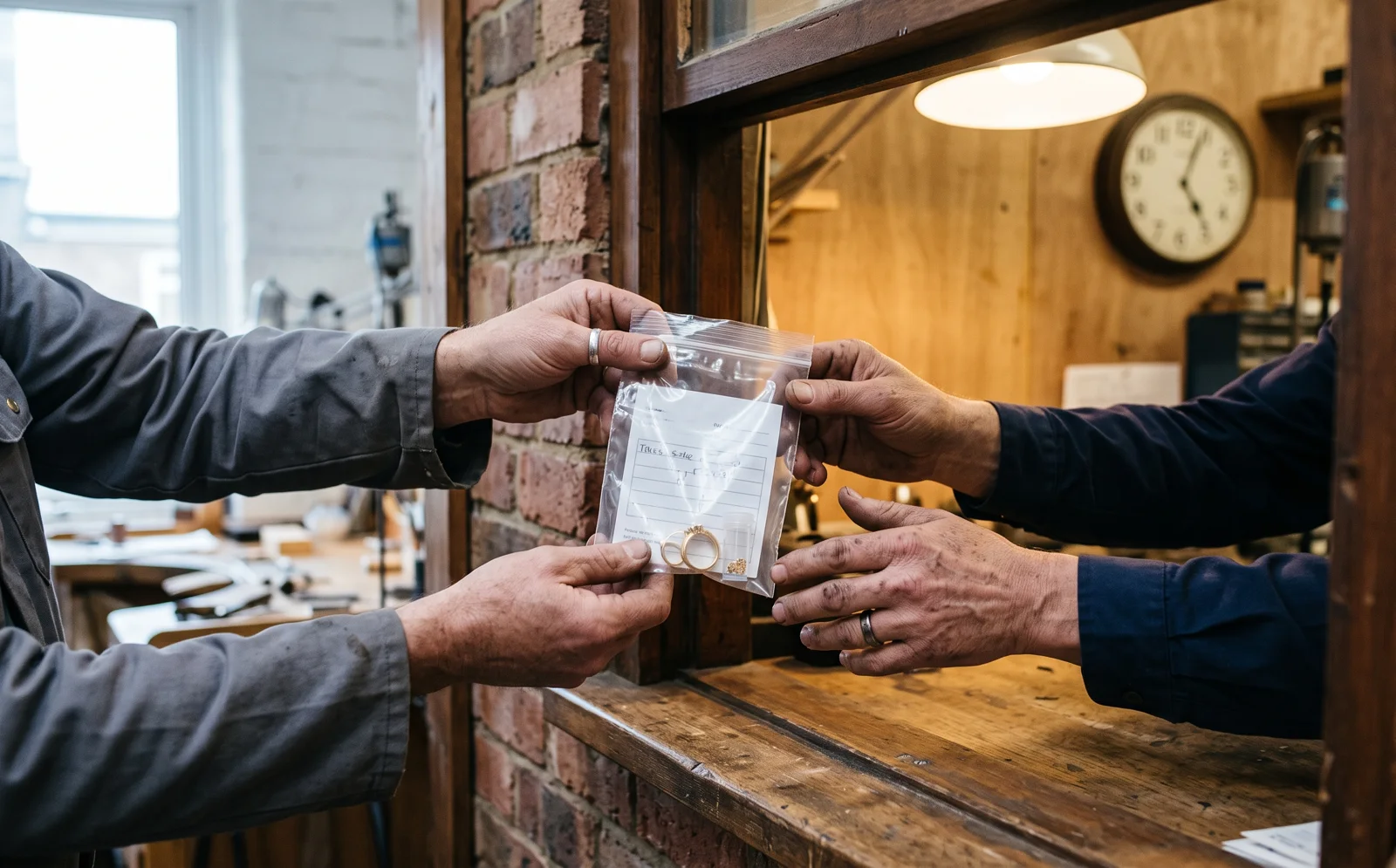
The trouble is rarely inside any single stage. Skilled vendors do good work. The trouble is in the hand-offs between stages, where a piece crosses from one business to another and the shared understanding of status, deadline, and specification has to survive the jump.
Where friction actually builds
Ask experienced jewelers where jobs go sideways, and you will hear the same themes. None of them are about craftsmanship.
Status blindness. Once a piece leaves your building, you often cannot say where it is without picking up the phone. Multiply that by the dozens of jobs in flight at any moment and you get a constant low hum of chasing.
Fragmented communication. Order details live in a text thread with the casting house, an email with the setter, a note taped to a job bag, and your own memory. When those sources disagree, the piece pays the price.
Pricing drift. Because metals pricing is live, quotes built on last week's numbers quietly erode margin. Many jewelers discover the gap only when they reconcile at the end of the month.
Memo and consignment sprawl. Goods out on memo or consignment sit at the edge of your visibility. It is easy to lose track of what is where, what is owed, and what needs to come back.
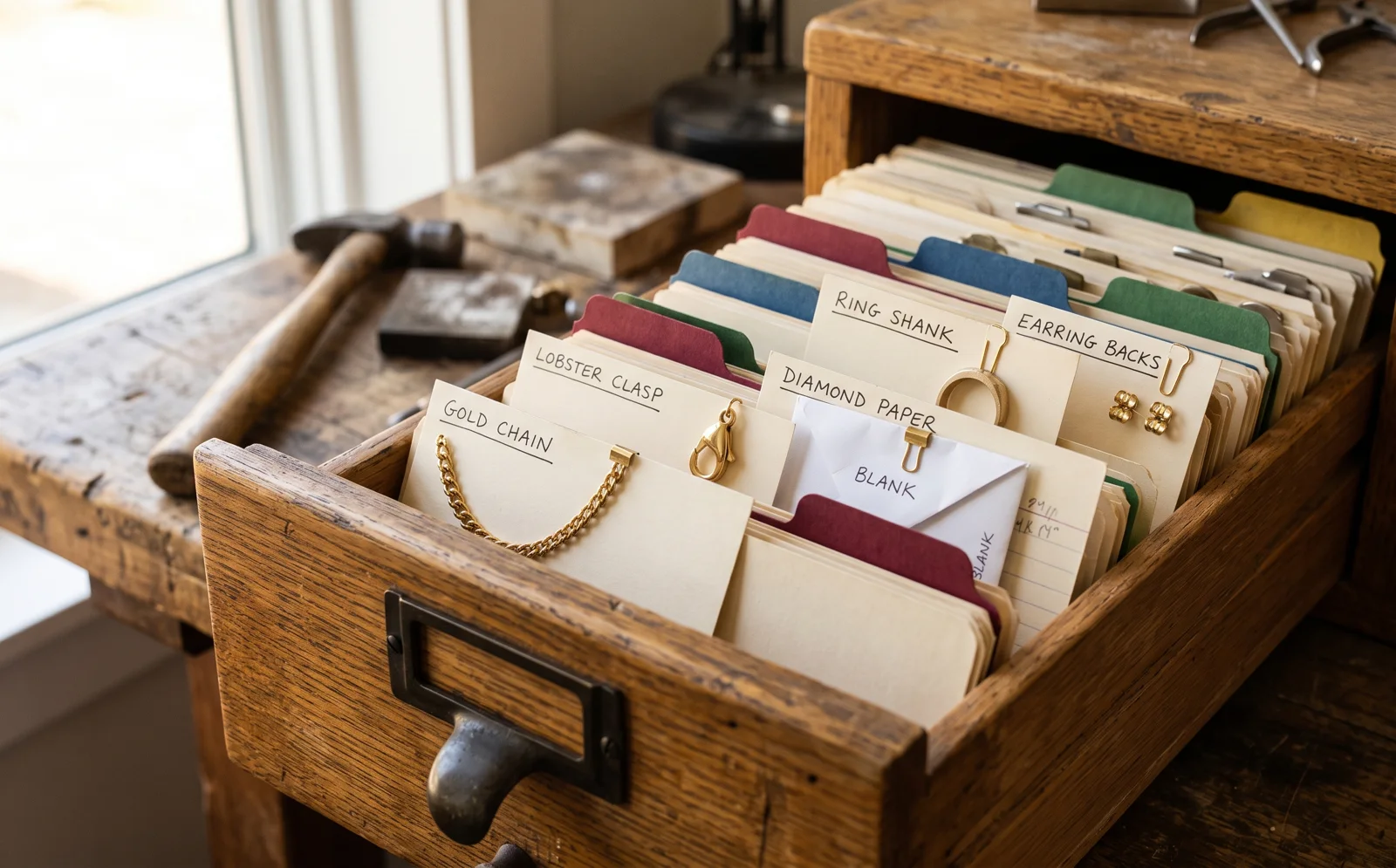
Handwritten history. When customer preferences, past repairs, and ring sizes live in one person's head or a paper file, the whole operation is one sick day away from a stall.
Building a chain that holds
You do not fix a supply chain by working harder inside each stage. You fix it by improving the connective tissue between stages. A few principles hold up across shops of every size.
Make status visible without a phone call. The single highest-leverage improvement is knowing where every job is at a glance. When status is shared rather than requested, the daily chase disappears and your team stops interrupting vendors for updates.
Keep one source of truth for each order. Specifications, deadlines, deposits, and vendor assignments should live in one place that everyone touching the job can see. If the answer to "what did the customer ask for?" depends on which channel you check, you have a source-of-truth problem.
Price against the live market. Quotes should reflect current metals pricing at the moment they are given, not the last time someone updated a spreadsheet. This is one of the simplest ways to protect margin without raising prices.
Track memo and consignment as first-class records. Anything that leaves your building on someone else's terms deserves the same rigor as a sale, so nothing slips through.
Own the customer record. Full history, preferences, past purchases, and repairs, held centrally so the relationship belongs to the business, not to whichever employee happened to help last time. If vendor coordination is where you feel the most pain, our companion piece on fixing vendor communication goes deeper on that specific link.
The multi-party problem most tools ignore
Here is the structural issue at the heart of jewelry supply chain management, and the reason generic software rarely fits.
Most industry tools are built for one seat at the table. Retail point-of-sale systems are excellent at the storefront but stop at your back door. Manufacturing systems are excellent inside the factory but assume you are the factory. Neither was designed for the reality that a jewelry order is a multi-party collaboration across independent businesses, retailer, wholesaler, manufacturer, and supplier, none of whom share a system.
Construction solved a version of this problem with platforms that let general contractors, subs, architects, and owners coordinate on a shared project. Jewelry has largely lacked an equivalent. The result is that coordination happens over WhatsApp, email, and spreadsheets, tools that were never designed to keep a five-vendor custom order on schedule.
| Approach | Strong at | Blind spot |
|---|---|---|
| Retail POS-first tools | The storefront and the sale | Everything upstream of your back door |
| Manufacturing ERP-first tools | The factory floor | The retail relationship and outside vendors |
| Spreadsheets and messaging apps | Being cheap and familiar | Shared status across parties; nothing is a source of truth |
| Purpose-built, multi-party platform | Cross-party coordination end to end | Requires committing to one system |
Where Jewelia fits
The friction in a jewelry supply chain almost always sits in the hand-offs — the moment a piece crosses from one business to another and the shared understanding of spec, status and deadline has to survive the jump. Jewelia is built around those crossings rather than around one seat at the table.
Production & Repairs gives every job a stage, an owner and a due date, including the stages you send to an outside caster or setter, which stay on your board with a date against them. Memo & Ledger tracks goods that leave the building line by line with 30/60/90 aging and a statement your counterparty can open. Inventory holds the metal, stone and certificate detail those jobs draw on, with a replacement valuation at today's metal spot prices.
Bottom line
Jewelry supply chain management is really the management of hand-offs, the moments when a valuable, often custom piece crosses from one business to another. Master those transitions with shared visibility, a single source of truth per order, live pricing, and disciplined memo tracking, and the rest of the chain gets a lot quieter.
See how Jewelia coordinates your whole supply chain in one place. Book a Jewelia demo →
Frequently asked questions
- What is jewelry supply chain management?
- It is the coordination of every party and step a jewelry piece passes through, from sourcing stones and metal to production, specialty finishing, quality control, and delivery. Because a single custom piece can involve five or more independent vendors, the discipline is mostly about managing hand-offs between businesses.
- Why are spreadsheets and messaging apps a problem for jewelry supply chains?
- They were never built to be a shared source of truth. When order details live across texts, emails, and paper notes, those sources drift out of sync, and no one can see a job's true status without making a phone call.
- What makes jewelry supply chains different from other industries?
- Jewelry orders are frequently custom, high in value, and routed through several independent specialty vendors rather than one linear pipeline. That multi-party structure is why generic retail or manufacturing software rarely fits the whole picture.
Stop reading, start clicking.
Open a live Jewelia company with real inventory, memo, jobs and reports already in it. One work email, no card, no sales call, nothing to install.