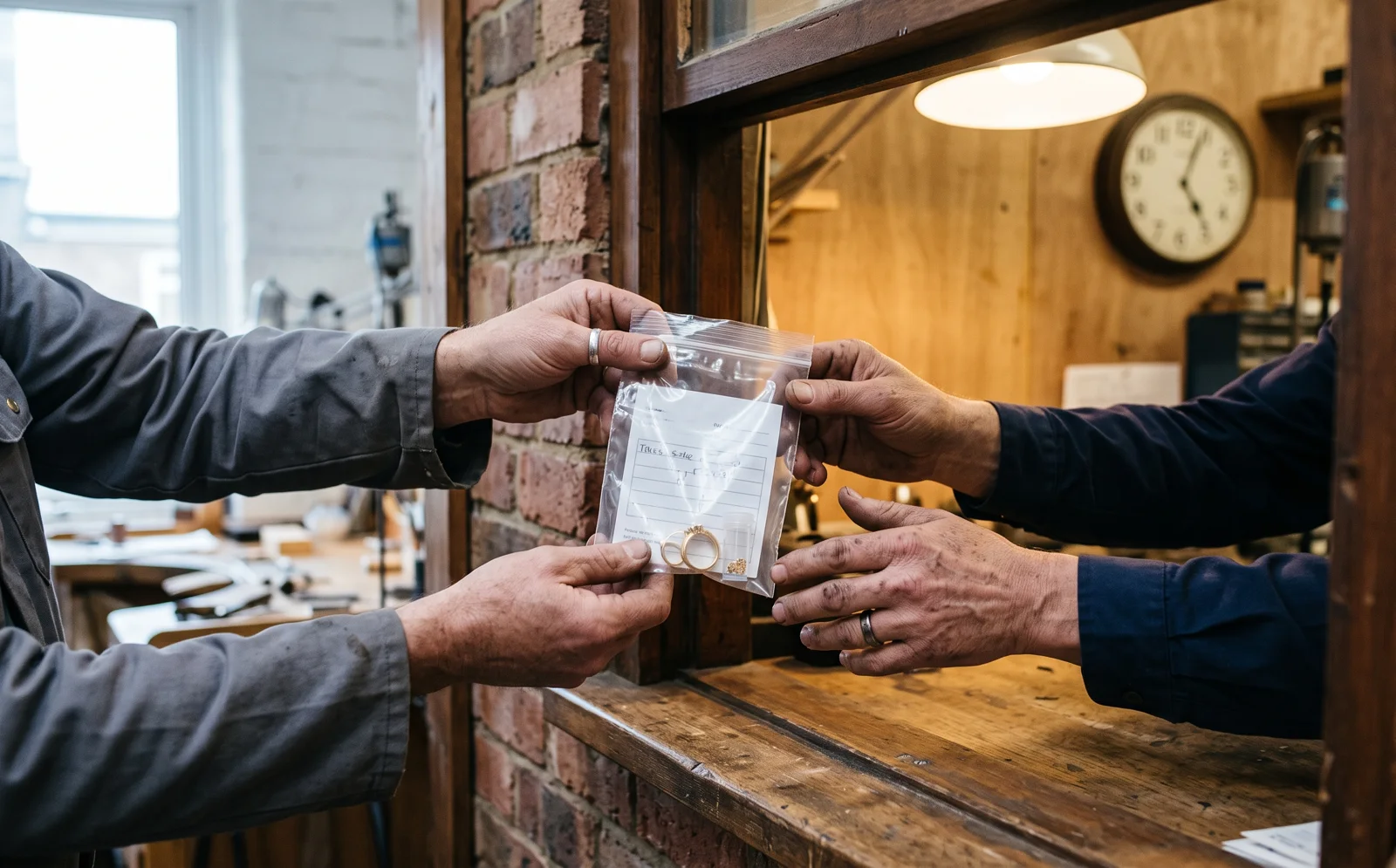
Short answer: treat every send-out as a tracked stage with an owner, a promised return date and an overdue flag — not as a piece that has temporarily left the building. Send the full spec and photographs with it so nobody has to call. Confirm receipt. And notice a slip because your board told you, not because the customer did.
The part of the timeline you don't control
In most jewelry businesses a large share of production happens outside the building. Casting, setting, engraving, plating, laser welding, CAD, appraisal — each is a separate business with its own queue and its own clock.
That is not a weakness. Specialisation is why the work is good. But it creates a specific failure mode, and it is the most common cause of a missed date in this trade: a piece that leaves your building usually leaves your attention with it. It is out of sight, so it falls out of mind, and you rediscover it when the client asks.
Coordinating only your own bench while treating outside vendors as black boxes leaves half your timeline uncontrolled. The fix is not more chasing. It is structure.
Outwork is a stage, not an absence
The single change that does most of the work: a send-out is a stage of the job, exactly like a stage on your own bench, with a name, an owner and a due date.
That means it appears on the board. It can be overdue. It shows up on a daily review. It has a status other than "gone."
Compare that to the default, where a piece is recorded as having left, and the next entry is whenever it comes back. In the gap, the job has no state at all — which is precisely why nothing flags when a vendor slips.
Three practices make the stage real:
Log what left, where it went, and when it is due back. All three at the moment it leaves, not reconstructed later.
Confirm receipt. Seconds of effort. It catches anything lost in transit, and it establishes that the vendor has received the piece and read the spec — which is not the same as having received it.
Flag anything past its promised return automatically. So a slip surfaces before the customer's date is at risk rather than after. This is the whole return on the exercise.
Send the information, not just the piece
Every question a vendor has to ask costs at least a day, and usually more, because of when answers actually get seen and acted on. The way to avoid the question is to have answered it in advance.
Attach the full specification to every send-out — metal, stones, sizing, finish, engraving detail, special instructions — plus photographs taken before the piece left, and any CAD files. That package does three jobs at once: it prevents the clarifying call, it defines what "correct" means when the piece comes back, and it documents the condition the piece was in when it left your care.
That last one matters more than it sounds. A mark that was already on a piece and a mark that appeared at a subcontractor look identical afterwards, and without a photograph the conversation is two recollections.
Define "done" before it goes
Ambiguity at the seams between stages is where days disappear. A piece is not "cast" until it is cleaned, inspected and flagged ready for the next hand.
Agree that definition with the subcontractor rather than assuming it. Does a setting job come back polished? Does a plating job come back inspected? Whatever the answer, it should be the same answer every time, because the next stage is scheduled on the assumption.
Batch around their schedule, not yours
If a caster runs on Tuesdays and Fridays, waxes need to be ready the day before — not "sometime this week." Missing a run by an hour costs days, and no amount of urgency on your side changes their schedule.
This is why vendor schedules belong in your planning rather than in your frustration. Working backwards from their run days is a small planning habit with an outsized effect on turnaround, and it is the kind of thing that should be recorded against the vendor rather than remembered.
Order long-lead inputs at approval
Related, and the other common self-inflicted delay: stones, findings and specialty materials should be sourced the moment a design is approved, not when the piece reaches the stage that needs them.
A ring cannot wait at the setter for a centre stone that has not been ordered. The lead time on that stone sits in front of all your own work, and the only way it does not become a delay is if it starts running at approval.
Agree the commercial terms once
Scope, price, date, insurance and damage responsibility, in writing, before the first job — then as a standing arrangement rather than a negotiation each time.
Verbal quotes over a call are where margins quietly disappear, and a vendor record with agreed terms removes the "I thought you said" conversation. On insurance specifically: do not assume your policy covers goods in a third party's possession, and do not assume theirs covers the value of what you sent. Ask, agree, record. More on vetting a new vendor here.
The daily pass
None of this works as a system you install once. It works as a five-minute habit.
A short daily scan of every open job — what moved yesterday, what is stuck, what is due out to a vendor, what is due back — catches problems while they are still cheap to fix. Three questions per job:
- What stage is it in?
- Who owns the next action?
- What is it waiting on?
A job goes silent when it is between stages, waiting on something, or parked with nobody owning it. The daily pass exists to make silence impossible, and outwork is where silence is most likely.
Measure the vendors, over time
Once send-outs are tracked stages, you get something you did not have before: a record. Dates promised against dates met. Rework rate. Whether questions come before starting or after. Whether invoices match quotes.
Across dozens of jobs those patterns are clear and actionable. Across three they are invisible. Which means the whole value depends on the record existing without anyone maintaining it deliberately.
Where Jewelia fits
This is the coordination layer the platform is built around rather than a feature added to it.
In Production & Repairs, any stage can be assigned to an outside caster, setter, engraver or plater and stays on your board with its own due date instead of disappearing. Stages are yours to define, so "at the setter" is a real stage in your workflow rather than a note. Photographs attach to the job at each step, and the full spec travels with it. Configurable stage forms capture what actually happened, including materials used.
The vendor sits in the CRM as an account with its terms and history, so the relationship belongs to the business rather than to whoever set it up. The Partner Portal gives regular partners a read-only view of the stock you choose — 10 partners on Professional, 50 on Enterprise.
The Planner turns the daily pass and the pre-deadline check-in into tasks with owners and due dates. Inventory carries low-stock alerts so long-lead materials are ordered rather than remembered. And analytics accumulates turnaround and throughput into vendor performance you can actually point at.
Related reading: reducing production delays, production coordination best practices, and the buyer's guide to jewelry vendor management software.
Bottom line
Make every send-out a stage with an owner, a due date and an automatic overdue flag. Send the complete spec and photographs so nobody has to call. Confirm receipt. Define "done" with the vendor rather than assuming it. Work backwards from their run days. Order long-lead materials at approval. Run a five-minute pass every morning. Do those seven things and the piece at somebody else's bench stops being the one you find out about last.
Frequently asked questions
- What counts as outwork in a jewelry business?
- Any stage of a job performed by someone who does not work for you — casting, stone setting, engraving, plating and rhodium, laser welding, CAD, appraisal, restoration. In most shops it is a meaningful share of the production timeline and almost all of the timeline you do not directly control.
- Why do off-site jobs go silent?
- Because they leave your building and leave your board at the same time. If a send-out is recorded as an absence rather than as a tracked stage with a due date, nothing flags when it is late, and the slip is discovered when the customer asks rather than when it happens.
- What should travel with a piece sent out?
- The complete spec — metal, stones, sizing, finish, special instructions — plus photographs taken before it left and any CAD files. The goal is that the vendor never has to call with a question, because every question costs at least a day and usually more given when the answer actually arrives.
- Should I confirm receipt on every send-out?
- Yes. It takes seconds, it confirms nothing went missing in transit, and it establishes that the vendor has both received the piece and read the spec. It also starts their clock at an agreed moment rather than a disputed one.
- How do I handle a subcontractor running late?
- Notice it before the customer does, which requires a promised return date logged at the moment the piece left and an overdue flag that fires on its own. After that it is a conversation, and having the original agreed date recorded makes it a short one.
- Who insures a piece while it is at a subcontractor?
- Whatever you have agreed, which is why it should be agreed in writing before the first job. A policy covering your own inventory does not automatically extend to goods in a third party's possession, and the subcontractor's cover may not match the value of what you sent.
Stop reading, start clicking.
Open a live Jewelia company with real inventory, memo, jobs and reports already in it. One work email, no card, no sales call, nothing to install.