Ask any jeweler what keeps them up at night and "the piece I forgot about" ranks near the top. Not because anyone is careless — precisely the opposite. It's because a busy shop juggles dozens of open orders at once, each at a different stage, some waiting on stones, some at an outside setter, some sitting quietly in a drawer that everyone assumes someone else is watching. In that kind of environment, a dropped ball isn't a character flaw. It's a system gap.
Good order tracking closes that gap. It's the discipline of always knowing, for every open order, exactly where it is, who has it, and what happens next. Get it right and the anxious "any update?" call disappears, clients trust you more, and your team stops doing status archaeology. Here are the best practices that make it happen.
The one rule everything else serves
Every order tracking best practice exists to guarantee one thing: no order can go silent. An order goes silent when it's between stages, waiting on something, or parked with no owner — and nobody notices until the client does. Everything below is a way to make silence impossible.
Best practice 1: One record per order, one place for all of it
Scattering an order's information across a paper envelope, a phone photo of the design, a line in a spreadsheet, and a note by the register is how balls get dropped. The moment a client calls, you're assembling the picture from four sources and hoping none is out of date.
Instead, keep a single record per order that holds everything: the spec, the stones, the client, the price, the promised date, and the current stage. When there's one authoritative record, "where is this order?" is answered by looking, not by hunting.
Best practice 2: Make the stage always current
A tracking record is only as good as its freshness. A stage field that says "casting" when the piece has been at the setter for a week is worse than no field at all, because it lulls you into false confidence.
The habit that keeps stages honest: update the stage at the moment of the handoff, not at the end of the day and not "when I get to it." When "moved to setting" is a small, immediate action, your board reflects reality, and reality is what lets you catch a stall early.
Best practice 3: Assign a next action and an owner
Tracking isn't just where an order is — it's what happens next and who does it. An order can be at a clearly labeled stage and still stall because everyone assumes someone else has the next move.
For every open order, keep two things visible:
- The next action ("send to setter," "call client for approval," "order center stone")
- The owner of that action
When both are explicit, a stalled order has a name attached to it, and daily review becomes a quick sweep for actions that haven't moved.
Best practice 4: Track the external steps too
A large share of dropped balls happen after a piece leaves your shop — at the caster, the setter, the engraver, the plating house. It's out of sight, so it falls out of mind, and you rediscover it only when the client asks.
Treat send-outs as tracked stages with their own promised return dates:
- Log what left, where it went, and when it's due back.
- Confirm receipt so nothing vanishes in transit.
- Flag anything past its promised return so it surfaces before the client's date is at risk.
The pieces you don't physically see are exactly the ones that need the most deliberate tracking.
Best practice 5: Run a daily review rhythm
Order tracking isn't a system you install once; it's a habit you practice daily. A short morning pass over every open order — what moved yesterday, what's stuck, what's due out or due back — catches problems while they're cheap to fix.
| Best practice | Prevents | Daily habit |
|---|---|---|
| One record per order | Scattered, stale info | Everything logged in one place |
| Always-current stage | False confidence | Update at the moment of handoff |
| Next action + owner | "I thought you had it" | Scan for actions that haven't moved |
| Track external steps | Silent send-outs | Flag overdue returns |
| Daily review rhythm | Late surprises | Five-minute morning sweep |
Best practice 6: Tie tracking to the client relationship
The final best practice connects order tracking to why it matters: the client. When an order's status lives against the client's full history — past purchases, preferences, other open orders — a status update becomes a relationship moment instead of a data lookup. You can reach out proactively ("your ring's at the setter, still on track for the 20th") because the information is right there, and proactive updates are what turn a one-time buyer into a repeat one.
Where Jewelia fits
No order should go silent — that is the whole discipline, and it is what Jewelia is built to enforce.
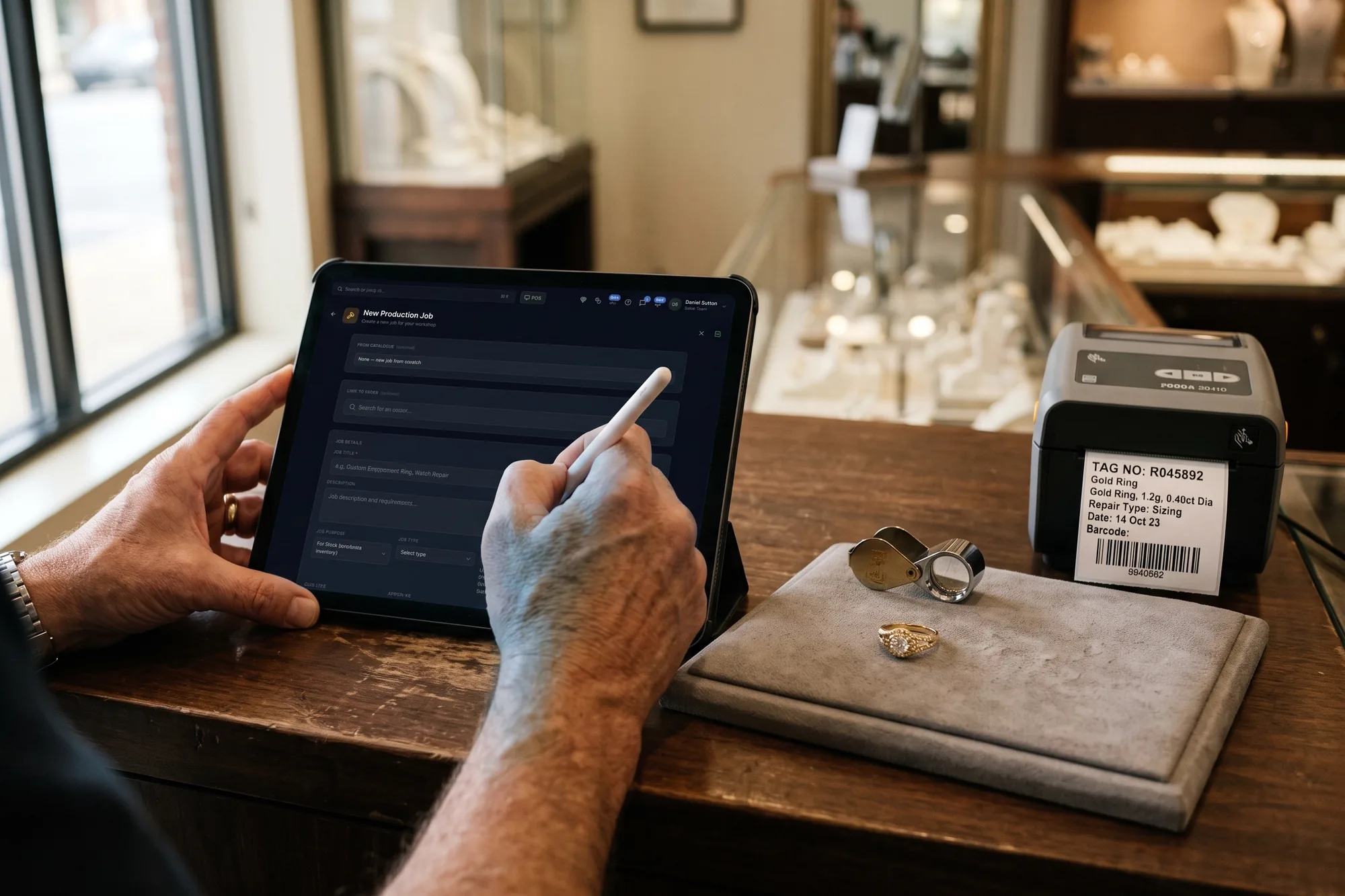
Every custom order and repair gets one record in Production & Repairs carrying the spec, the photos, the promised date and the current stage, with one owner per stage and a barcoded tag so the physical piece and the digital job stay connected. Send-outs to an outside caster, setter or plater are tracked steps with their own due dates, so an off-site piece stays on the board. Each job sits against the client's full history in the CRM, so a proactive update is a glance rather than an investigation — and clients are notified automatically when a job changes to the stages you choose. The Planner turns the daily sweep into a list rather than a habit you have to maintain.
Bottom line
Zero dropped balls comes down to one principle — no order goes silent — supported by a handful of habits: one record per order, an always-current stage, a named next action, tracked external steps, and a daily review. Practice those and order tracking stops being a source of anxiety and becomes a quiet competitive advantage.
Give every order and repair one place to live. Book a Jewelia demo →
Frequently asked questions
- What's the most important jewelry order tracking best practice?
- Keeping every order's current stage genuinely up to date, updated at the moment of each handoff. A stale stage field creates false confidence and is where most dropped balls originate.
- How do I track pieces I've sent to an outside caster or setter?
- Treat each send-out as a tracked step with a promised return date. Log what left and where, confirm receipt, and flag anything overdue so it surfaces before the client's deadline is at risk.
- Do spreadsheets work for order tracking?
- They can for a very small shop, but they don't update themselves, don't tie to client history, and don't handle external vendor steps well. Purpose-built software like Jewelia keeps the record current and connected without the manual upkeep.
Stop reading, start clicking.
Open a live Jewelia company with real inventory, memo, jobs and reports already in it. One work email, no card, no sales call, nothing to install.