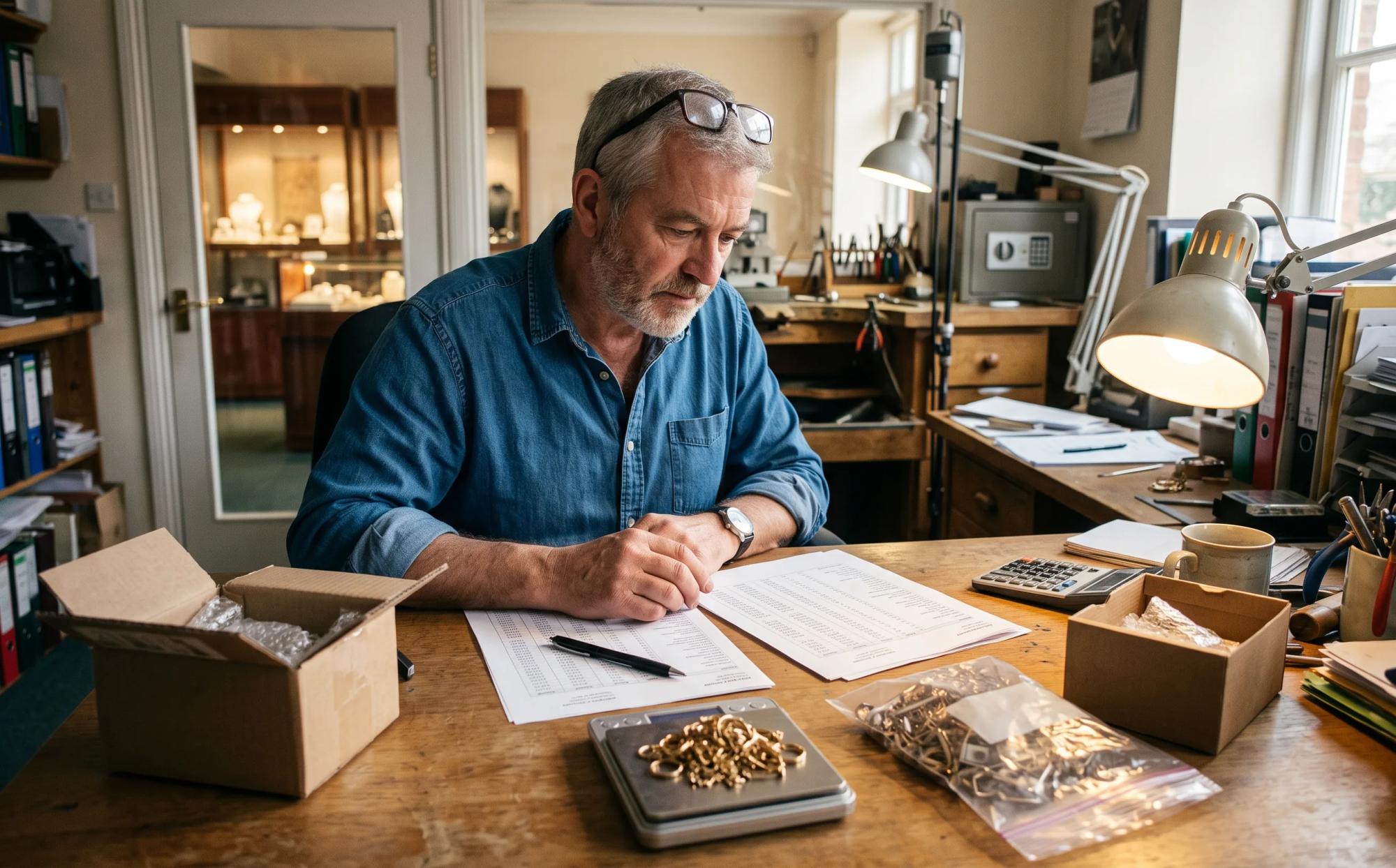
A great custom order workflow is invisible when it works. The client approves a design, the piece moves through the right hands in the right order, updates happen without anyone chasing them, and it arrives on time looking exactly like the sketch. When a workflow falls apart, though, it fails in the same few places every time — and those failure points are remarkably consistent across studios of every size.
This piece is about designing a workflow that holds under real conditions: rush jobs, difficult stones, a client who changes their mind, a vendor who runs late. Not a theoretical process chart, but a structure sturdy enough for the messy reality of custom jewelry.
Start from the client, work backward
A custom order workflow isn't really about your bench — it's about a promise you made to a person. So the design starts at the finish line: a specific piece, delivered by a specific date, matching what the client approved. Everything upstream exists to protect that promise.
Work backward from the delivery date and you get a natural sequence of stages, each with its own deadline. The mistake most shops make is planning forward ("we'll start when we can") instead of backward ("this must reach the setter by the 12th to hit the 20th"). Backward planning turns a vague hope into a schedule with built-in early-warning signals.
The anatomy of a workflow that holds
Strong custom order workflows share the same skeleton. The stages vary by shop, but the load-bearing elements don't:
- A defined stage list. Design → approval → materials sourced → wax/CAD → casting → setting → finishing → QC → ready. Name yours and use it for every job.
- One owner per stage. At any moment, exactly one person is responsible for the next action. No shared responsibility, which is another word for no responsibility.
- A clear "done" definition per stage. A stage is complete only when the piece is inspected and flagged ready for the next hand — not when someone is "basically finished."
- A single source of truth. The order's spec, stones, client record, and current stage live in one place everyone can see, not scattered across a folder, a phone, and someone's memory.
Get those four right and most of the classic failures simply can't happen.
The three places workflows break
1. The intake gap. The design and the spec live in the salesperson's head or a handwritten note, and details get lost on the way to the bench. Fix it by capturing the complete spec — metal, stones, sizing, finish, engraving, client preferences — as a structured record the moment the order is approved. If the bench has to call the front to ask a question, the intake failed.
2. The silent handoff. A piece finishes one stage and waits because the next person doesn't know it's ready. Fix it by making "ready for next stage" an explicit, visible event rather than an assumption.
3. The update black hole. The client hears nothing for two weeks, gets anxious, and calls — and now you're doing status archaeology. Fix it by keeping the current stage always visible against the client's record, so an update is a glance, not an investigation.
Handle change without chaos
Custom work means changes: a client swaps a stone, adjusts a setting, moves a date. A workflow that falls apart treats every change as a fire. A workflow that holds absorbs it because the order is a living record, not a frozen ticket.
When a change comes in, three things need to update together: the spec, the price, and the timeline. If a client upgrades the center stone, the quote should reflect the new stone and the metal value at that moment, and the schedule should shift if the new stone has a longer lead time. Keeping those three in sync is what separates a controlled change from a downstream surprise.
| Workflow element | Weak version | Version that holds |
|---|---|---|
| Intake | Handwritten note, verbal handoff | Structured spec captured at approval |
| Stage tracking | "Ask whoever's at the bench" | Visible current stage for every job |
| Ownership | Shared / assumed | One named owner per stage |
| Client updates | Reactive, after a call | Current stage always visible on the record |
| Changes | Handled ad hoc | Spec, price, and timeline update together |
Keep pricing honest as the piece evolves
Custom jewelry lives and dies on margin, and margin quietly erodes when metal prices move between quote and finish. A workflow that holds ties pricing to live metals values at the moment of the quote, so the number you give the client reflects reality — not last month's spot price. When a design changes mid-stream, the same discipline applies: reprice against current values before the change is confirmed.
This isn't about squeezing the client. It's about not accidentally eating a loss because gold moved while a ring sat at the setter.
Where Jewelia fits
Custom order workflows fall apart when the order's information is scattered, the hand-offs are invisible and no one holds a single source of truth.
Jewelia is built to be that source of truth. The CRM captures the client, the spec, the quote and the deposit at approval, and the quote is built from live inventory rather than retyped. Production & Repairs moves the job through the stages you define with one owner per stage, photos attached at each step, materials drawn against the job, and outwork to a caster or setter tracked with its own due date. The Planner holds the client check-ins and the pickup. And when a client changes their mind, the spec, the price and the timeline all live on the same record, so the three move together instead of drifting apart.
Bottom line
A custom order workflow that doesn't fall apart is built backward from the client's promise, runs on a defined stage list with one owner per step, and keeps the spec, price, and timeline in sync as the piece evolves. Nail the intake, make handoffs explicit, and keep status visible — and the workflow disappears into the background where it belongs.
Give every custom order one home from quote to pickup. Book a Jewelia demo →
Frequently asked questions
- What stages should a jewelry custom order workflow include?
- A common sequence is design, client approval, materials sourcing, wax/CAD, casting, setting, finishing, QC, and ready for pickup. Name your own stages and apply the same list to every job so nothing is improvised.
- How do I stop details from getting lost between the front and the bench?
- Capture the complete spec — metal, stones, sizing, finish, engraving, and client preferences — as a structured record at approval. If the bench has to call the front with questions, your intake step needs tightening.
- How do I handle a client changing their order mid-production?
- Update three things together: the spec, the price (repriced against current metals values), and the timeline. Treating the order as a living record rather than a frozen ticket keeps changes controlled instead of chaotic.
Stop reading, start clicking.
Open a live Jewelia company with real inventory, memo, jobs and reports already in it. One work email, no card, no sales call, nothing to install.