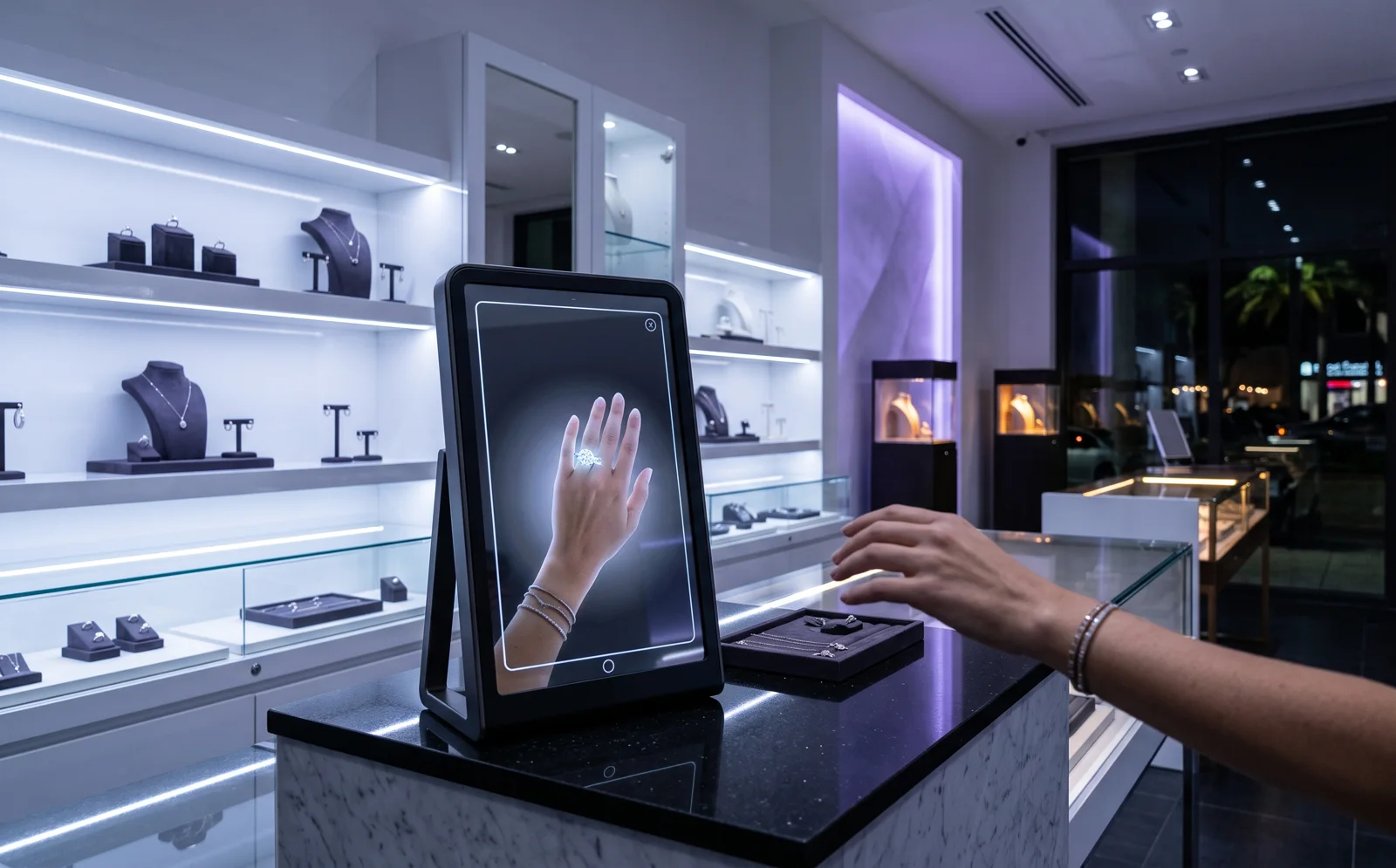
Imagine a jewelry business a few years from now. A client walks in about a custom piece; the salesperson pulls up their full history—past purchases, preferences, the anniversary coming up—in a moment. A quote goes out built on live metal prices, accurate to the minute. The job moves through production with everyone seeing exactly where it stands. When it's ready, the client gets a warm, personalized message that took seconds to prepare. Nothing about the craft or the relationship has changed. Everything about the friction around it has.
That's not a far-off fantasy. It's the direction jewelry retail technology is already moving, and the pieces are largely available today. This piece explores where things are heading—not with breathless prediction, but with a grounded view of the shifts underway and what they mean for the modern jeweler. The future here is optimistic and very much within reach.
The end of fragmentation
For most of the digital era, jewelers assembled their operations from whatever tools they could find—a point-of-sale system here, a spreadsheet for inventory there, a notebook for repairs, an inbox for client communication. Each tool did one thing, and none of them talked to each other. The jeweler became the integration layer, carrying information between systems by hand.
The clearest theme in the future of jewelry retail technology is the end of that fragmentation. The trajectory is toward single, connected platforms where information entered once flows everywhere it's needed. Inventory, customer history, production, repair, memo, consignment—held together rather than scattered. This isn't merely a convenience; it's the foundation that makes every other advance possible.
Real-time everything
The future is real-time. Where jewelers once worked from figures that were current as of the last manual update, technology increasingly keeps everything live.
- Live metals pricing means quotes and inventory valuation reflect the market as it moves, protecting margins automatically.
- Live job status means anyone can see where a piece is in production or repair without asking around.
- Live inventory means what's on the floor and what's in the system always match.
The cumulative effect is a business that operates on current reality rather than yesterday's snapshot. Decisions get faster and more confident because the information underneath them is fresh.
AI as a quiet, helpful presence
The future of AI in jewelry retail is less dramatic and more useful than the headlines suggest. Rather than a separate, attention-grabbing tool, AI is becoming a quiet layer inside the software jewelers already use—showing up right where the work happens.
Picture a suggested follow-up message waiting next to a client's record, ready for you to personalize. An inventory insight surfacing on your dashboard about a style that's moving fast. Help assembling a quote so it's ready sooner. Recognition of demand patterns across your custom orders and client records, so you can prepare for the season ahead. In every case, the jeweler stays in control—AI handles the first pass and the pattern-spotting; the human makes the call. That's the realistic, genuinely useful shape of AI's future here: assistance, not replacement.
The customer experience gets more personal, not less
There's an assumption that more technology means a colder experience. The reality points the other way. When systems handle the administrative load, staff have more attention for the human moments that define a jewelry purchase.
A complete customer record means every client is greeted as someone whose history and preferences are known—not a stranger. Freed from data entry, salespeople spend more time in genuine consultation. Timely, personalized communication—drafted quickly, sent thoughtfully—keeps relationships warm between visits. The future of jewelry retail technology is, paradoxically, more personal, because the technology absorbs the impersonal work.
The frontier: a connected supply chain
Here's the shift with the most room to run. Almost all retail technology, across every industry, has focused inside the walls of a single business. But jewelry is a deeply interconnected trade—jewelers, suppliers, and partners constantly moving goods, memo, and information between them. That external web has been the least digitized part of the industry, still running largely on phone calls, emails, and paper.
The future points toward technology that connects the supply chain itself, letting information flow between businesses. This is the frontier that could reshape the trade most profoundly, bringing to jewelry the kind of multi-party, cross-business collaboration that shared-project platforms brought to construction. When the links between businesses become as connected as the systems within them, the whole industry moves faster.
What this means for jewelers today
You don't have to wait for the future to arrive to start benefiting from it. The practical steps are clear:
| To move toward the future | Do this now |
|---|---|
| End fragmentation | Consolidate onto one connected, purpose-built platform |
| Operate in real time | Adopt live pricing and live job status |
| Benefit from AI | Organize your data so AI has something useful to work with |
| Deepen relationships | Use complete customer records to personalize every interaction |
| Prepare for the connected supply chain | Choose tools built to reach beyond your own walls |
The through-line: the jeweler who consolidates onto modern, purpose-built software today is already living in the future the rest of the industry is heading toward.
How Jewelia is building that future
Most of what this article describes as the future already exists in parts; what is missing is having it in one place.
Jewelia is that attempt: POS, inventory, CRM, production and repairs, memo and consignment, 40-plus reports and an AI that reads your actual data, in one cloud platform with no server behind it. That cross-business layer is the bit almost every other system leaves to email.
Bottom line
The future of jewelry retail technology is connected, real-time, and more personal—and the jewelers building on purpose-built platforms today are already there. Book a Jewelia demo →
Frequently asked questions
- Will more technology make jewelry retail feel impersonal?
- It's the opposite when done right. When systems handle the administrative load, staff have more attention for consultation and relationship-building, and complete customer records let every client be greeted as someone whose history is known.
- What's the biggest frontier in jewelry retail technology?
- Connecting the external supply chain—letting information flow between jewelers, suppliers, and partners rather than stopping at each business's door. It's the least digitized part of the trade and the area with the most room to transform.
- How can a jeweler start moving toward this future today?
- Consolidate onto one modern, purpose-built platform with live pricing, complete customer records, and real-time job status. That foundation delivers value immediately and positions the business for AI and connected-supply-chain capabilities as they mature.
Stop reading, start clicking.
Open a live Jewelia company with real inventory, memo, jobs and reports already in it. One work email, no card, no sales call, nothing to install.