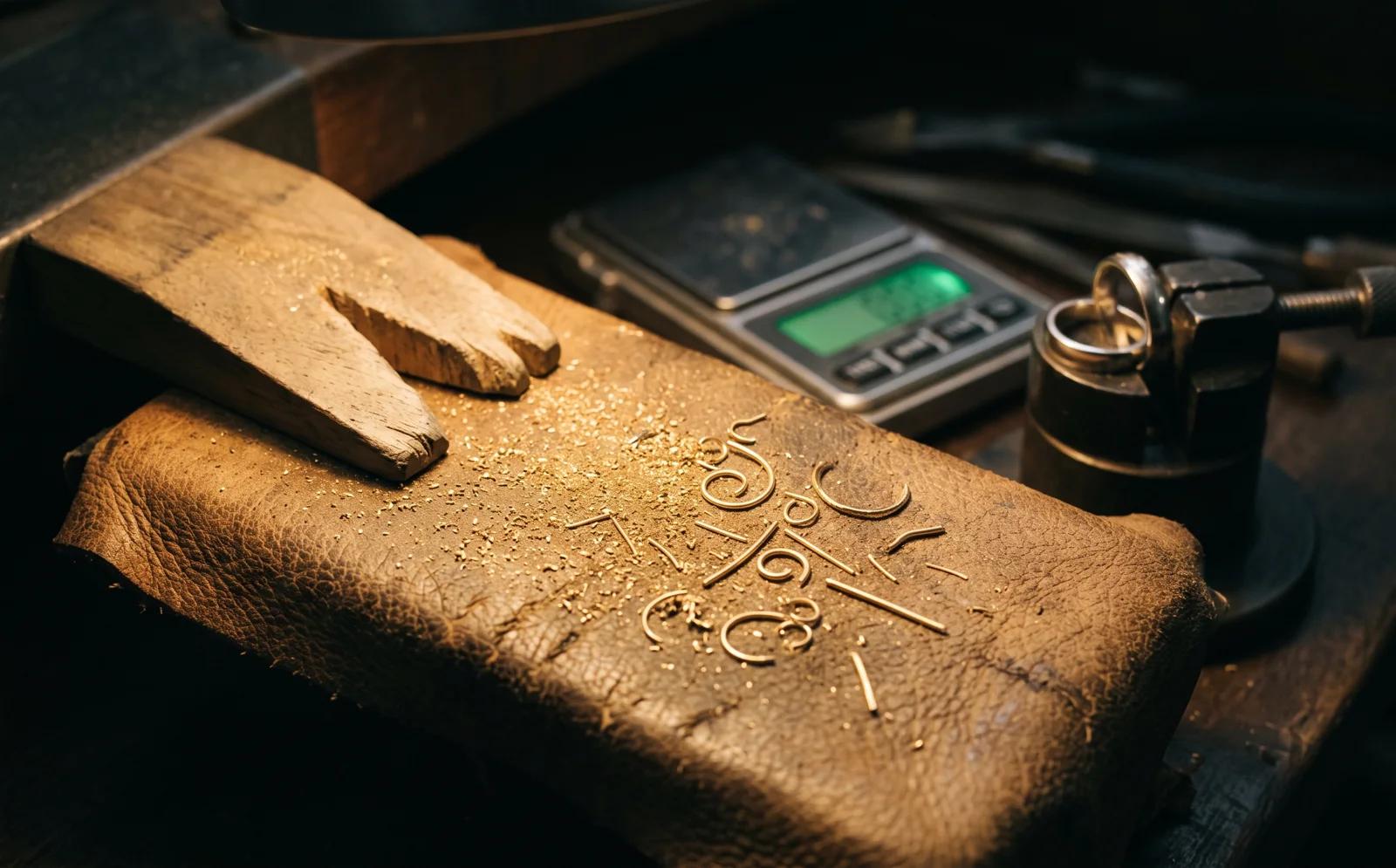
There is a specific moment where generic manufacturing software stops being useful to a jeweler. It is the moment you issue 48 grams of 18k to a caster and get back 41 grams of finished rings plus a bag of sprues, and the system wants to know which SKU the missing seven grams was.
Standard ERP is built on a clean assumption: materials are countable parts with a stable standard cost, and a bill of materials consumes a predictable quantity of them. Almost none of that is true at a jewelry bench. This piece is about the five places that assumption breaks, what it costs you when it does, and which systems actually address it.
Everything below links to its source. Where something is our own argument rather than a published fact, we say so.
1. Metal does not stay where you put it
Precious metal is lost at every stage — casting trees, sprues and buttons, bench filing, polishing and buffing, floor sweeps, and the sludge in the ultrasonic (Ganoksin). It is not waste in the ordinary manufacturing sense, because you get much of it back. It is inventory in transit through your workshop floor.
How much comes back is not trivial. Fourteen-karat gold polishing sweeps "can yield as much as 4%" recoverable precious metal (Ganoksin). And the recoverable stream is far wider than metal offcuts — refiners will take "sandpaper, buffs, brushes, rags, polishing wheels, filters, sludge, carpet, flooring, dedicated work clothes and shoes," and advise checking "sink traps, air filters, carpets, and even air conditioning return vents" (MJSA Journal via Ganoksin).
Refining settlement is then a reconciliation, not a receipt. The trade uses a standard measure — net weight shipped divided by ounces or dollars returned — to establish a predictable ratio and compare refiners (Ganoksin). Best practice is to separate scrap by metal and karat, weigh before shipping, state the weight on the packing slip, and use an independent assayer, because "their only vested interest is in giving you accurate results" (MJSA Journal).
One counterintuitive point worth carrying into any refiner negotiation: a higher quoted return percentage is not automatically a better deal. "The refiner with the lowest settlement rate might well end up yielding you more of a return on your metal than the party with the higher quote" (MJSA Journal).
What the software has to do: record issued metal weight per job, returned finished weight per item, and scrap separately — then tell you when loss on a job exceeds what you expected. PIRO is the clearest published example: it "calculates the metal lost during casting and it will warn you if the loss percentage is higher than previously anticipated" (PIRO), and tracks loss during polishing too (PIRO). Zyple, an SAP Business One vertical, tracks "wastage or value addition" (Zyple).
Without this, your metal loss is invisible until the annual count, and you cannot distinguish a bad casting run from theft.
2. Your raw material is repriced twice a day
Gold's benchmark price is set by auction twice each London business day, at 10:30 and 15:00; silver once daily at noon; platinum twice, at 09:45 and 14:00; palladium twice more (LBMA). These are not indicative quotes — they are the industry's costing reference, administered under the IOSCO Principles for Financial Benchmarks and used "in valuation and pricing activities and in transactions and financial products" (LBMA).
Standard ERP costing models were designed for materials whose price changes quarterly. A standard cost with a periodic variance analysis is a reasonable approach to steel. It is a poor approach to a material that reprices while a job is still on the bench.
That last sentence is our argument, not a sourced claim — we could not find a trade publication or vendor document stating it directly. The auction mechanics above are sourced; the conclusion is ours to defend.
What the software has to do: hold metal at weight and karat rather than at a frozen unit cost, and reprice on a live feed. Several systems do — PIRO updates market prices automatically (PIRO), Valigara offers "real-time Inventory Valuation, based on precious metal and gemstone prices" (Valigara), and Gem Logic carries live pricing for gold, silver, platinum and palladium (Gem Logic).
3. A certified stone is not a quantity
A GIA-inscribed diamond carries its report number laser-etched on the girdle, invisible to the naked eye but readable under 10× magnification, and verifiable against GIA's Report Check (GIA). That stone is not three units of "1.2ct round brilliant." It is a specific serial-numbered asset that has to be allocated to one specific job, and if it ends up in the wrong ring the paperwork is wrong in a way that matters to the customer and the insurer.
Then there is the ownership problem. Much of the stone inventory in a jeweler's safe is not the jeweler's. Memo — goods sent on trust, ownership retained by the sender — has been widespread "for generations" and dates to at least the 1890s, with terms typically 15 to 30 days (Rapaport). It exists because consumers ask for very specific stones — a "1.3- to 1.49-carat, G color, SI2 clarity" — and no retailer can stock every combination (Rapaport).
The trade's own risk controls tell you what the data model needs: wholesalers file UCC-1 statements and request "segregated, tagged, or trademark-stamped items to ensure product identification," precisely because "difficulty identifying intermingled inventory" is a known failure mode (Rapaport).
What the software has to do: treat a stone as a serialized asset with a lab report number, allocate it to a job, and know whether you own it. NetSuite's jewelry vertical is explicit about this combination — stones by lot with "carat, cut, clarity, and lab ID," finished pieces by serial, and support for memo and consignment inventory (NetSuite). Luxare treats Memo as a first-class order type alongside Asset, Sample, Stock and Special (Luxare).
The accounting consequence — that memo stock must stay out of your inventory valuation and COGS until it sells, while standard ERP assumes on-hand means owned — is our analysis rather than a sourced claim. But it is the one that shows up in your year-end.
4. Half your routing happens in someone else's workshop
Outwork is not an exception in jewelry manufacturing, it is an organised sector. The UK trade directory Benchpeg lists standing categories for setting services, casting services, CAD/CAM services, wax modelling, pearl and bead stringing, hand engraving, rhodium plating, polishing and pattern making (Benchpeg). Most workshops send pieces out for at least one of these.
This is not ordinary subcontracting. In standard manufacturing you ship components and receive different components. In jewelry you hand over a specific, high-value, partly-finished, serialized object containing allocated stones, and you expect that exact object back, with its weight reconciled on return. It is a custody transfer of a valuable asset that happens to have a purchase order attached.
The distinction above is ours; the existence and scale of the outwork sector is sourced.
What the software has to do: model an outwork leg as a routing step with custody, weight out and weight in — not as a purchase. NetSuite's job costing "captures labor, materials by weight, and outside services" (NetSuite). PIRO supports "vendor manufacturing and outsourcing" with job assignment and cost tracking (PIRO). Diaspark's ERP has a vendor portal and tracks "orders processed in-house and overseas" (Diaspark). JewelSteps advertises subcontract manufacturing (JewelSteps), and Zyple tracks karigar outwork (Zyple).
5. In the UK, one routing step is a legal gate
If you manufacture or import in the United Kingdom, hallmarking is not a finishing option. Under the Hallmarking Act 1973 it is an offence to supply or offer to supply an unhallmarked article described as gold, silver, platinum or palladium, subject to the Schedule 1 exceptions (legislation.gov.uk).
The weight thresholds below which hallmarking is not required are platinum 0.5g, gold 1g, palladium 1g, silver 7.78g (Birmingham Assay Office). And critically: "Hallmarks must be applied by an official Assay Office — manufacturers and importers can't add them themselves" (Birmingham Assay Office).
Read those two facts together and the software requirement follows. Hallmarking is a compulsory outwork leg whose applicability depends on the finished weight of the individual piece. The routing is not fixed per style; it is computed per item. That framing is ours; the legal facts are sourced.
This section is UK-specific. The United States has no equivalent compulsory assay-office system, and we have not verified the EU or Indian BIS regimes — do not generalise it.
What the market actually offers
Jewelry-native systems
PIRO is the most specific and the most transparent. Cloud only, with the FAQ stating plainly there is "no option for self-hosting, on-premises installation, or offline access" (PIRO). Pricing is published: Fusion Starter $299/month, Pro $599, Enterprise $999, additional limited users $70, PIRO Retail from $169 (PIRO). On manufacturing it addresses more of this article than anyone: casting trees, metal loss with tolerance alerting, automatic cross-metal casting error prevention, issued-versus-returned weight reconciliation with integrated scale support, automatic inventory depletion, BOM with variants, and labour cost calculated from process type, worker hourly rate and logged time (PIRO, PIRO, PIRO). Worth noting that parts of PIRO's feature documentation are blocked to crawlers, so their stone-setting, QC and CAD capabilities are unknown to us rather than absent.
Luxare by Diaspark offers a manufacturing execution module with configurable stage gating — "each stage is configured to progress only after the previous one is completed" — and QC at every step (Luxare). Deployment is offered as cloud, on-premises or desktop (Luxare). Pricing is not published. An oddity worth knowing: Diaspark's older ERP page is still live and is more jewelry-specific than the newer Luxare marketing — it names production requests, workbags, vendor portal, style costing, and costing that aggregates "metal type, diamond, color stone, finding details, labor, duty, surcharge" (Diaspark). If you are evaluating Luxare, ask which of that survived the rebrand.
JewelMate / Logic Mate ranks for this term but we could not verify any manufacturing functionality on any of their pages — the product is positioned as retail POS and wholesale ERP (Logic Mate). We are not asserting it lacks manufacturing; we are saying we could not find it either way. Ask them directly.
Smaller and regional: JewelAcc (India, with process-specific handling named for Dokiya, Kadali and item types — JewelAcc); JewelSteps (the most complete generic MRP list — work orders, batch production, BOM/MRP, labour costing, subcontract manufacturing, WIP — but no casting, metal loss, CAD or hallmarking claims — JewelSteps); and JewelryAdmin (production workflows with QC checks at each stage — JewelryAdmin). None publish pricing.
Verticals built on someone else's platform
Two products in this category are not standalone software, and you should know that before you buy:
e-Jewelry365 is a jewelry vertical on Microsoft Dynamics 365 Business Central, listed on Microsoft AppSource. Business Computing are explicit that the goal "was never to start from scratch as a 'jewelry software' per se" (e-Jewelry365). Zyple is likewise a jewellery vertical implemented on SAP Business One by an SAP partner (Zyple).
That is a legitimate model with a real trade-off: you inherit a mature financial platform and a large implementation ecosystem, and you inherit its cost and implementation timeline too.
Generic ERP with a jewelry page
NetSuite has the strongest first-party jewelry vertical of any horizontal vendor, and it is genuinely good on the themes in this article — metals by weight, stones by lot with lab ID, finished pieces by serial, job costing with outside services, memo and consignment (NetSuite). What it does not mention is casting workflow, karat and alloy calculation, metal loss or refining yield. Pricing is not published; licences combine platform, modules and users plus a one-time implementation fee.
Odoo has no first-party jewelry page at all. What ranks is third-party Apps Store modules (example) and implementation-partner blogs. Odoo's own pricing is published and cheap — US$24.90 per user per month for all apps (Odoo) — but the jewelry logic is maintained by a third party against a moving Odoo version line. Price that risk before you price the licence.
MRPeasy has a real first-party jewelry landing page offering "serial number, lot, and batch tracking" (MRPeasy), but the jewelry content is largely customer examples rather than features — no metal weight, casting, stone management or scrap handling. ERPAG's jewelry page is a news article rather than a product vertical, with generic BOM and inventory content (ERPAG).
The one that trips everyone: serialized and batched
Here is a structural problem worth naming, because it catches systems that handle everything else.
A custom engagement ring is a one-off serialized piece through design, setting, finishing and QC. But at the casting stage it is not a one-off at all — multiple distinct jobs go onto one casting tree, batched by metal and karat, and PIRO auto-assigns jobs to trees "based on the metals that the job is cast in" precisely to stop cross-metal errors (PIRO). Both models are real, in the same order, at different stages. And one-off is not a niche: Green Lake Jewelry Works produces "more than 2000 custom orders per year" (Ganoksin).
So your routing has to be serial at one end, batch in the middle, and reconcile weight across the transition. NetSuite tracks finished pieces by serial (NetSuite), MRPeasy offers serial, lot and batch tracking (MRPeasy), JewelSteps supports batch production (JewelSteps). Whether any of them handles the transition cleanly is something you should make them demonstrate rather than confirm on a call.
We could not source a trade article stating that generic ERP specifically fails at mixed serial/batch routing in jewelry — the coexistence of both models is sourced, the failure claim is our observation.
Where Jewelia fits
We are a cloud platform covering retail, wholesale and manufacturing in one database, with published pricing at $179, $399 and $999/month plus a custom Enterprise Plus tier. Production tracks jobs through the bench with assignments, due dates, CAD file storage, and metal and labour costs rolled into the item; memo and the shared ledger handle goods you hold but do not own, with both sides seeing the same balance; inventory carries stones with certificate detail.
Two honest limits. If your core problem is casting yield specifically — trees, flasks, issued-versus-returned weight to the gram — PIRO has published more depth there than we have, and we would rather tell you that than lose your trust in month three. And we are newer than Luxare or JewelMate, with a correspondingly thinner public review history.
What we would put up against either: you can open the demo and inspect the whole system right now, with one work email and no sales call, which is not true of anyone else in this section.
What to ask on the demo
Make them show you these, on screen, with real numbers:
- Issue 50g of 18k to a job, return finished pieces and scrap, and show me the loss percentage and whether it flags as abnormal.
- Allocate a specific GIA-certified stone to a specific job, then show me that certificate on the finished piece's record.
- Send a half-finished ring to an outside setter and receive it back — show me custody, weight out and weight in.
- Show me a piece that is serialized through setting but was cast on a tree with eleven other jobs, and reconcile the metal across that step.
- Show me memo stock in my safe that is not mine, and prove it is excluded from my inventory valuation.
- Reprice my metal inventory on today's fix and show me the effect on stock value.
If you manufacture in the UK, add: show me how a piece under and over the hallmarking weight threshold route differently.
Our sourced per-vendor comparisons are at /compare, including PIRO, Luxare/Diaspark and JewelMate.
Frequently asked questions
- What is jewelry manufacturing ERP software?
- Jewelry manufacturing ERP is production software that understands precious metal and stones as materials: it tracks metal by weight rather than by unit, calculates loss through casting and polishing, allocates specific certified stones to specific jobs, routes work through bench stages like setting and finishing including work sent to outside specialists, and costs labour by process. Generic manufacturing ERP models materials as countable parts at a standard cost, which is where it breaks.
- Can I use NetSuite or Odoo for jewelry manufacturing?
- NetSuite has a genuine first-party jewelry vertical that advertises tracking metals by weight, stones by lot with carat, cut, clarity and lab ID, finished pieces by serial, job costing including outside services, and memo and consignment inventory. Odoo has no first-party jewelry page at all — its jewelry functionality comes from third-party Apps Store modules and implementation partners, which means the jewelry logic is maintained by someone other than Odoo against a moving version line. That is a materially different support risk.
- How much does jewelry manufacturing ERP cost?
- Almost nobody publishes. PIRO is the exception, at $299, $599 and $999 per month for its Fusion tiers plus separately quoted implementation. Jewelia publishes $179, $399 and $999 per month. Luxare, JewelMate, JewelAcc, JewelSteps, e-Jewelry365, Zyple, JewelryAdmin, NetSuite, MRPeasy and ERPAG all quote on request.
- Why does metal loss matter so much in jewelry ERP?
- Because the loss is real, continuous and valuable. Metal disappears into casting sprues and buttons, bench filings, polishing sweeps, floor dust and sink traps, and it is recovered later through refining. Refining is a reconciliation event, not a receipt — the trade uses a standard ratio of net weight shipped to ounces returned to compare refiners. A system that cannot record issued weight, returned weight and scrap per job cannot tell you whether your loss is normal or whether metal is walking out of the door.
- What is the difference between jewelry ERP and jewelry POS?
- POS is the counter: selling, taking payment, handling repairs and layaway. ERP is everything behind it: materials, job routing, costing, purchasing and stock valuation. Some vendors do one well and bolt on the other. PIRO is a manufacturing system with a POS extension; most retail jewelry POS products have no manufacturing at all. If you both make and sell, check which half the vendor actually built first.
Stop reading, start clicking.
Open a live Jewelia company with real inventory, memo, jobs and reports already in it. One work email, no card, no sales call, nothing to install.