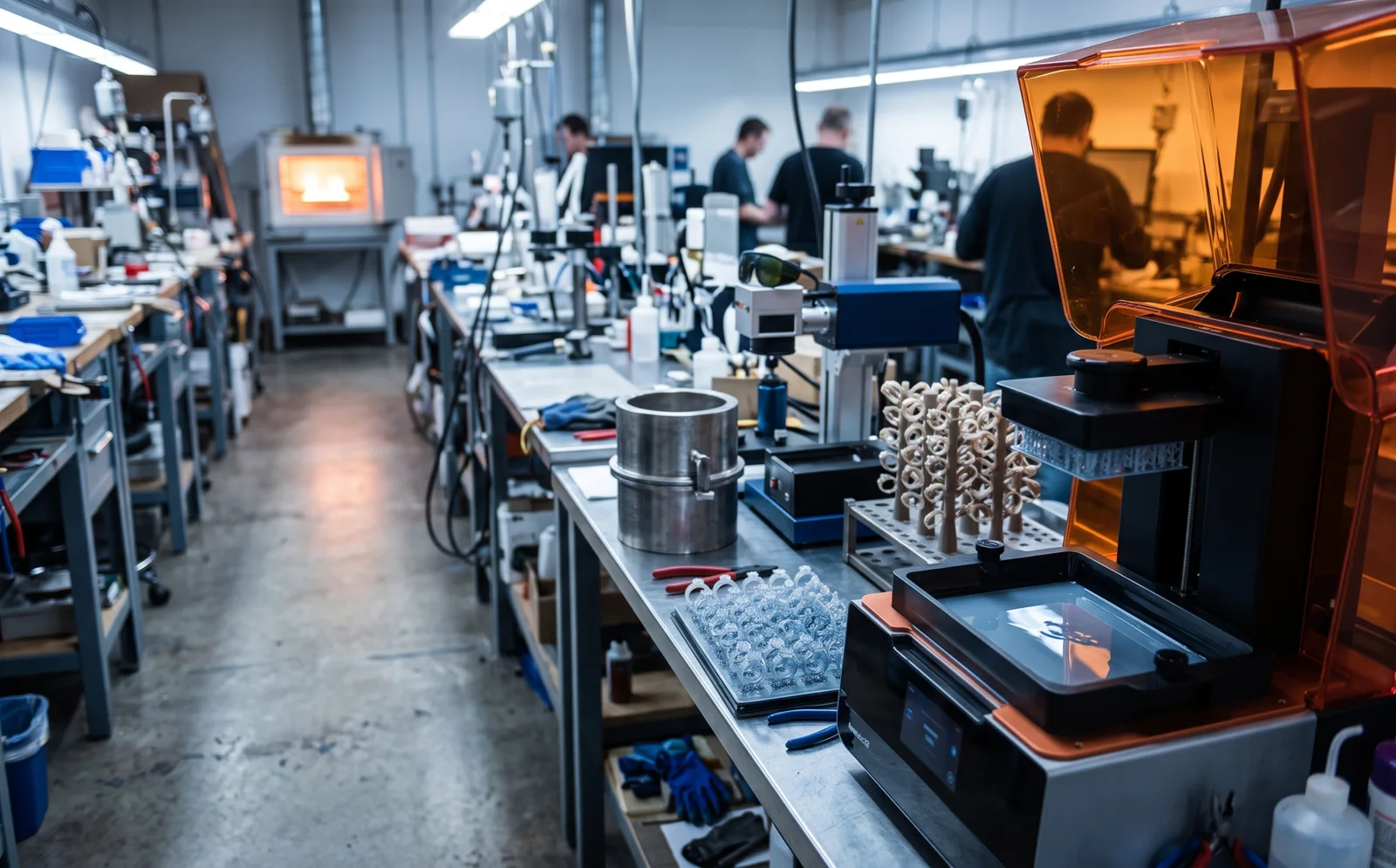
Manufacturing jewelry is a choreography of materials, benches, and deadlines. Metal is cast, stones are set, pieces move through stages, and orders — from retailers, wholesalers, and direct clients — have to be met on time and at the right cost. The technology you run underneath that choreography can either keep it in sync or leave you reconciling by hand.
The short answer for manufacturers: You need software that handles production workflow (routing work through stages), job costing, and inventory valuation with real depth — the domain of manufacturing-oriented systems. But you also increasingly need something those legacy systems weren't built for: smooth coordination with the outside partners you produce for. The best modern setup covers both production depth and supply-chain collaboration without forcing you into complex, dated software you dread using.
This guide covers what manufacturers need, honestly weighs legacy ERP against modern platforms, and helps you choose. For the wider landscape, see the software comparison.
What manufacturing software has to get right
Production is unforgiving of vague software. A manufacturer's core needs are specific:
- Production and repair workflow. Routing a job through its stages — casting, setting, polishing, QC — with visibility into where every piece is.
- Bill of materials and job costing. Knowing what each piece truly costs in materials and labor, so pricing holds up.
- Inventory with real-time valuation. Raw metals and stones shift in value; your holdings and work-in-progress should reflect current reality.
- Order management. Handling orders from retailers and wholesalers, with the client and every order in one place.
- Live metals pricing. Quoting and costing at current metals prices to protect margin.
These are the table stakes. A tool that can't route production or cost a job accurately isn't a manufacturing tool, whatever else it does well.
The honest trade-off: legacy ERP vs. modern platform
Historically, manufacturers reached for jewelry ERP software built around production. Those systems can be genuinely powerful on the factory floor.
| Consideration | Legacy manufacturing ERP | Modern purpose-built platform |
|---|---|---|
| Production depth | Often deep and mature | Strong if truly purpose-built; verify depth |
| Ease of use | Can be complex and dated | Designed to be modern and simpler |
| Implementation | Longer, heavier | Typically lighter |
| Retail/selling side | Often secondary | Usually integrated |
| Supply-chain coordination | Rarely a focus | An emerging core strength |
The fair summary: legacy ERP can offer the most mature production features, but often at the cost of complexity, a steep learning curve, and dated day-to-day usability. Modern platforms aim to deliver strong production capability in a simpler package while adding the cross-party coordination older systems lack. Which wins depends on how much raw production depth you need versus how much you value usability and connection to your partners.
Costing and valuation: where manufacturers win or lose margin
For a manufacturer, costing isn't paperwork — it's survival. If you don't know the true, current cost of a piece, you either underprice and lose margin or overprice and lose the order.
Two capabilities matter most. Accurate job costing rolls up materials and labor per piece so your prices reflect reality. Real-time inventory valuation keeps your raw materials and work-in-progress valued at current metals and stone prices, not stale figures. Pair those with live metals pricing on quotes, and your numbers stay honest even as the market moves. A manufacturer running on stale-cost data is quietly leaking margin on every job.
The gap even good ERP leaves: coordinating with your partners
Here's what most manufacturing software, however capable on the floor, doesn't solve. You don't produce in isolation — you produce for people. Retailers place custom orders. Wholesalers order in volume. Suppliers feed you materials. Coordinating all of that — order status, approvals, hand-offs, updates — has traditionally happened over email, phone, and chat apps, entirely outside the ERP.
That's a real gap, because those hand-offs are where delays and miscommunication creep in. The frontier in 2026 is platforms that treat this external collaboration as a core feature — connecting you to the outside parties you produce for, so a retailer's custom order or a wholesaler's bulk request flows into your production process instead of arriving through a scattered thread. For a manufacturer, closing that gap is as valuable as any floor-level feature.
How to evaluate manufacturing technology
- Demo your real production flow. Watch a job route through your actual stages, not a generic sample.
- Stress the costing. Have the vendor cost a representative piece end to end.
- Check valuation and metals pricing. Confirm holdings and quotes reflect current prices.
- Weigh usability honestly. A powerful system your team avoids is worse than a capable one they'll use daily.
- Ask about partner coordination. How do orders from retailers and wholesalers enter your workflow?
- Total the implementation cost. Time, training, and migration — not just license price.
Don't overbuy raw ERP horsepower you won't use; don't underbuy and end up back in spreadsheets. Aim for the fit.
Where Jewelia fits
Manufacturers usually need two things at once: real control of the floor, and a way to work with the retailers and wholesalers who commission the work. Most systems give you one.
Production & Repairs carries the floor — configurable stages, a job board with owner and due date, forms completed at each stage, QC checkpoints, and outwork to a caster, setter or plater tracked with its own due date rather than disappearing. Inventory holds the metal, stone and certificate detail with bills of materials, and reports a replacement valuation at today's metal spot prices alongside cost. Analytics turns the stage forms into throughput and turnaround by job type, which is how you find your actual constraint. There is a page for this: Jewelia for manufacturers.
Bottom line
Manufacturers need real production depth and accurate costing — plus the partner coordination legacy ERP leaves out. Choose the fit, not just the biggest system.
Frequently asked questions
- Do I still need a full ERP to manufacture jewelry in 2026?
- Not necessarily. Legacy ERP can offer the deepest floor-level features, but modern purpose-built platforms increasingly deliver strong production and costing in a simpler package — while adding partner coordination ERP lacks. Evaluate depth against usability for your operation.
- What's the biggest hidden cost in manufacturing software?
- Stale costing and valuation. If your system prices jobs off outdated metals figures, you leak margin on every piece — which makes real-time valuation and live metals pricing more than conveniences.
- Why does supply-chain coordination matter for a manufacturer?
- Because you produce for retailers and wholesalers, and those orders and approvals traditionally arrive through scattered email and chat. A platform that pulls that coordination into your production flow reduces the delays and miscommunication that live in the hand-offs.
Stop reading, start clicking.
Open a live Jewelia company with real inventory, memo, jobs and reports already in it. One work email, no card, no sales call, nothing to install.