Search "jewelry inventory software" and most of what comes back is not jewelry software. It is general inventory software with a jewelry landing page — Sortly, SalesBinder, Craftybase — sitting above the systems actually built for the trade.
That is not necessarily wrong. If you are a maker working in silver wire and beads, a general tool at $24/month may be exactly right, and paying $400/month for memo functionality you will never use would be silly. But the moment your safe contains a certified stone, or a parcel that belongs to a supplier, the fit breaks in ways that are not obvious until year-end.
This piece maps where that line sits. Every claim links to its source, and where a vendor's site simply does not mention something we say "not mentioned" rather than "cannot do it" — absence from marketing copy is not absence from the product.
What jewelry inventory has to handle
Items that are one of one. Most inventory software is built on quantity on hand. A jeweler's stock is frequently a single piece with its own cost, its own stones and its own history. The industry framing is direct: unlike apparel or electronics, jewelry demands tracking of "weights, carats, metals, and certifications," features "generic retail software cannot handle effectively" (PIRO).
Certificates as first-class data. A GIA report number laser-inscribed on a girdle is verifiable against GIA's Report Check (GIA). Certificates "can be stored and linked to each item," which "supports audits, and builds customer trust" (PIRO). WJewel tracks the certificate number as a field in its own right (WJewel).
Four ownership classes in one safe. This is the big one. On any given day a jeweler holds owned stock, memo-in from suppliers, customer-owned goods in for repair, and goods out on approval — each accounted for and insured differently. Jewelers block insurance covers workmanship damage during service, with optional cover for "jewelry given to customers on approval" and "merchandise given to another jeweler in the trade" (Jewelers Mutual).
Memo is the load-bearing one. The supplier retains ownership, and the trade protects itself with UCC-1 filings and by "segregating and tagging items" because "difficulty identifying intermingled inventory" is a known failure (Rapaport). The accounting consequence is stated plainly in the trade: memo goods "are not your inventory for accounting purposes. They are off-balance-sheet until sold" (WJewel).
Metal that reprices daily. Stock value moves with the metal fix even when nothing sells. Live metal pricing is why Valigara offers "real-time inventory valuation, based on precious metal and gemstone prices" (Valigara) and Gem Logic carries live gold, silver, platinum and palladium pricing (Gem Logic).
Capital that sits still. Because value concentrates in individual pieces, aged stock matters more here than in most retail — hence "identify aged inventory tying up capital" (The Edge) and inventory-age reporting (Jewel360).
The horizontal tools, measured against that
Here is what each of the six general tools ranking for this term actually claims on its own jewelry or product pages.
| Tool | Published price | Serialization | GIA/IGI certs | 4Cs | Metal weight | Memo | Barcode | Cost per piece |
|---|---|---|---|---|---|---|---|---|
| Sortly | $0–$299/mo | Not mentioned | "Certifications" generically | Carat only | Not mentioned | Not mentioned | Yes | Not mentioned |
| SalesBinder | $9–$99/mo | Not mentioned | Not mentioned | Not mentioned | Not mentioned | Not mentioned | Yes | Weighted average |
| Craftybase | $20–$349/mo | Not mentioned | Not mentioned | Not mentioned | Not mentioned | Consignment only | Not mentioned | Yes — BOM-driven |
| Orderry | $39–$199/mo | Yes | Not mentioned | Not mentioned | Not mentioned | Not mentioned | Yes | Not mentioned |
| Valigara | From $600/mo | Not mentioned | Yes | Not named | Valuation only | Yes | Not mentioned | Not mentioned |
| Gem Logic | $299–$2,500/mo | Not mentioned | Yes | Not named | Live pricing | Yes | Yes | Not mentioned |
Read across that table and the pattern is stark. Of six tools, one mentions per-item serial numbers. Two mention GIA or IGI. None names the full 4Cs as tracked fields. None mentions RFID. None publishes a specific-identification costing method — and the two that do state a method, SalesBinder and Craftybase, both use weighted average, which is the wrong model for one-of-a-kind pieces.
A fair caveat: Sortly publishes 1 to 20 custom fields by tier and SalesBinder advertises unlimited custom fields (SalesBinder). You could hand-build certificate and 4C fields in either. You would be building a jewelry data model yourself, and maintaining it, and it still would not give you memo accounting.
Where each one genuinely fits
Sortly is the best-presented of the group and the jewelry page is real — photos per item, documentation attachments, organising "by carat, jewel type, style, or budget" (Sortly). Free tier is 100 items and one user; barcode scanning is on free, but barcode label creation needs the Ultra tier at $149/month list (Sortly). Good for a small maker or for tracking equipment and supplies. Not a fine-jewelry stock system.
SalesBinder is the cheapest credible option at $9/month, with genuine multi-location transfers including an in-transit status (SalesBinder). But it costs stock at "weighted averaged cost" blending (SalesBinder), and has no jewelry page at all.
Craftybase — now rebranding to Stocksmith — is the one with a real costing engine, built around bill of materials and true cost per piece for makers: "track wire, beads, and findings. Know your true cost per piece" (Craftybase). If you make production jewelry from components and need accurate COGS for tax, this is a genuinely good fit. It is maker software, not fine-jewelry retail software, and its costing is weighted average rather than specific identification.
Orderry is the only horizontal tool that promises what a jeweler would recognise as serialization: "assign a serial number to each high-value piece," print barcode and serial-number labels, transfer between locations, organise by warehouse and bin, and consume materials on repair orders (Orderry). No certificates, no 4Cs, no metal weight, no memo — but the bones are closer than the others.
Valigara and Gem Logic are arguably jewelry-native rather than horizontal, and it shows: both handle GIA/IGI and memo. Valigara is really a multichannel e-commerce and PIM platform — it handles "jewelry memo workflows — from sending items on consignment" and generates purchase orders, receipts and transfers (Valigara) — at from $600/month plus a setup fee, with per-tier detail not published (Valigara). Gem Logic publishes a full ladder — Essential $299, Growth $699, Partner from $2,500 per month, with a 14-day card-free trial (Gem Logic) — and tracks "stones, metals and finished pieces with photos, certificates and provenance" with GIA/IGI certificate scanning and lookup (Gem Logic).
What the jewelry-native systems do differently
The Edge tracks "every item with serialized IDs and diamond-specific attributes" and is explicit that stores need tracking "by cut, clarity, color, carat, metal type, vendor, and serial number" — and tracks "consignment and memo inventory separately from owned stock" (The Edge).
Jewel360 keeps "consignment and memo items separate from your owned stock," shows complete per-piece history by serial number, deducts repair parts from stock, and reports inventory age (Jewel360). Their own guidance on consignment is a good specification in itself: commission splits tracked per item, consignor payout records, and flagging items nearing the end of their consignment period (Jewel360).
PIRO calculates item prices automatically from attributes — "the price of diamonds based on the 4C's" — retrieves GIA diamond data and certificates automatically, bills memo items when they sell or returns them to stock when they come back, and tracks location "from many different warehouses down to the level of individual worker" (PIRO).
WJewel is the most complete published inventory claim set we found: tracking "every piece by metal, karat, stone, weight, and certificate number — across one store or fifty," memo in from diamond suppliers and estate dealers and memo out to customers and salespeople with aging and automated reminders, trade-ins, insurance-ready reporting with photos, per-piece chain-of-custody audit trails, and RFID audits claiming 200-plus tags in under 60 seconds (WJewel). Those RFID performance figures are the vendor's own and we have not verified them independently.
The costing problem nobody publishes
Here is a question worth putting to every vendor on your shortlist, because not one of them answers it on their website: what costing method do you use for a unique piece?
Weighted average cost is the standard answer in general inventory software, and SalesBinder and Craftybase both say so explicitly. It is also structurally wrong for one-of-a-kind goods. If every unit is a distinct asset with its own acquisition cost, the correct method is specific identification — this exact ring cost this exact amount — and averaging across a "category" of unique pieces produces a cost of goods sold figure that is wrong on every single sale, in both directions.
We could not find a single vendor page, jewelry-native or horizontal, that states its costing method for serialized pieces. That absence is a finding, not an accusation — but it means you have to ask, and you should ask your accountant what answer they want to hear before you do.
Where Jewelia fits
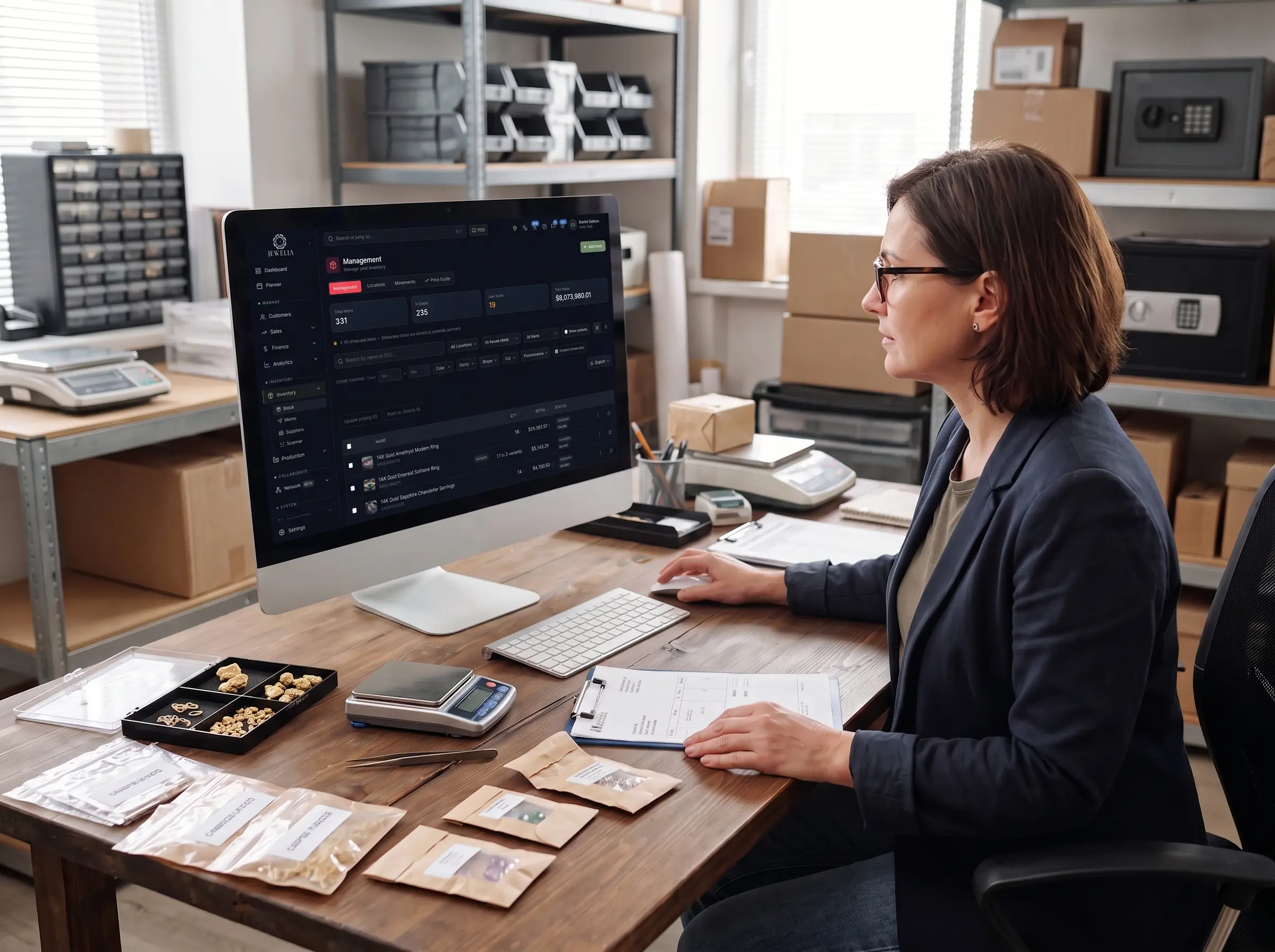
Jewelia's inventory carries pieces individually with stone and certificate detail, multi-location stock, and barcode support, and it shares one database with POS, production and repairs and the memo ledger — so a piece sold at the counter, a stone allocated to a job at the bench, and a parcel out on memo all move the same records. Pricing is published at $179, $399 and $999/month plus a custom Enterprise Plus tier.
The memo ledger is the piece we would point at against everything above. Memo out and the shared ledger are on our entry tier, and both sides of a memo see the same balance rather than reconciling two private spreadsheets by phone.
Honest limits: we do not currently advertise RFID, which WJewel does and which matters if you are auditing thousands of tags. And we are newer than The Edge or WJewel, with a thinner public review history to show for it.
Choosing, quickly
If you make jewelry from components and mostly need accurate cost and tax reporting, Craftybase is a good, cheap fit. If you are tracking tools, supplies or low-value stock, Sortly is fine. If you sell mainly online across marketplaces, Valigara is built for that.
If your safe holds certified stones, goods on memo, or customers' own jewelry, you want a jewelry-native system — and the test is not the feature list, it is this demo sequence:
- Receive a memo parcel from a supplier, sell one stone from it, and show me the supplier balance and the payable it created.
- Show me that memo stock excluded from my inventory valuation report.
- Add a certified diamond with its lab report number and show me that certificate on the finished piece.
- Take in a customer's ring for repair and show me that it is in my safe but not in my stock value.
- Reprice my metal on today's fix and show me the change in stock value.
- Tell me, in writing, what costing method you use for a unique serialized piece.
Our sourced per-vendor comparisons are at /compare. If you represent a vendor here and something is wrong, email hello@jewelia.io and we will correct it.
Frequently asked questions
- What is jewelry inventory software?
- Jewelry inventory software tracks stock the way jewelers actually hold it: individual serialized pieces rather than SKU quantities, stones with their gemological attributes and lab certificate numbers, metal by weight and purity, and — crucially — goods in your safe that you do not own, such as memo from a supplier or a customer's ring left for repair. A general inventory app tracks countable items at an average cost, which is the wrong model for almost all of that.
- Can I use Sortly or a general inventory app for jewelry?
- For a small maker with beads, wire and findings, yes. Sortly's jewelry page advertises photos, custom fields, certifications generically and organising by carat. What it does not mention is per-item serialization, GIA or IGI certificate numbers as a tracked field, metal purity, memo or consignment, or cost per unique piece. If you hold certified stones or goods on memo, you will end up keeping a spreadsheet beside it.
- How much does jewelry inventory software cost?
- Horizontal tools are cheap: Sortly runs $0 to $299/month by item count, SalesBinder $9 to $99/month by record count, Orderry $39 to $199/month. Jewelry-specific systems cost more because they do more: Gem Logic publishes $299 to $2,500/month, Valigara starts at $600/month plus setup, and Jewelia publishes $179 to $999/month. The gap buys certificates, memo, metal weight and serialization.
- What is memo inventory and why does it complicate stock control?
- Memo is jewelry trade practice where a supplier sends you goods that remain their property until you sell them — standard since at least the 1890s, typically on 15 to 30 day terms. It complicates stock control because the goods are physically in your safe but are not your asset: they should not appear in your inventory valuation or cost of goods sold until they sell, and when they do sell they create a payable to the supplier. Most general inventory software treats on-hand as owned, which quietly overstates your stock value.
- Does any jewelry inventory software support RFID?
- Among the systems we checked, WJewel is the only one advertising RFID inventory audits, claiming 200-plus tags read in under 60 seconds. Lightspeed's jewelry page also mentions RFID alongside barcodes. None of the six horizontal inventory tools we examined mention RFID at all. Treat vendor performance claims as claims until you see them in your own store.
Stop reading, start clicking.
Open a live Jewelia company with real inventory, memo, jobs and reports already in it. One work email, no card, no sales call, nothing to install.